
Changes in morphology… from oxide?
Looking back at production over the last year, I noticed that our porosity has dropped considerably. Now that we have a good handle on controlling pinhole density, it is time to focus on controlling morphology again. Below are two examples of a 15 nm and 30 nm pnc-Si film produced this month and one year ago.

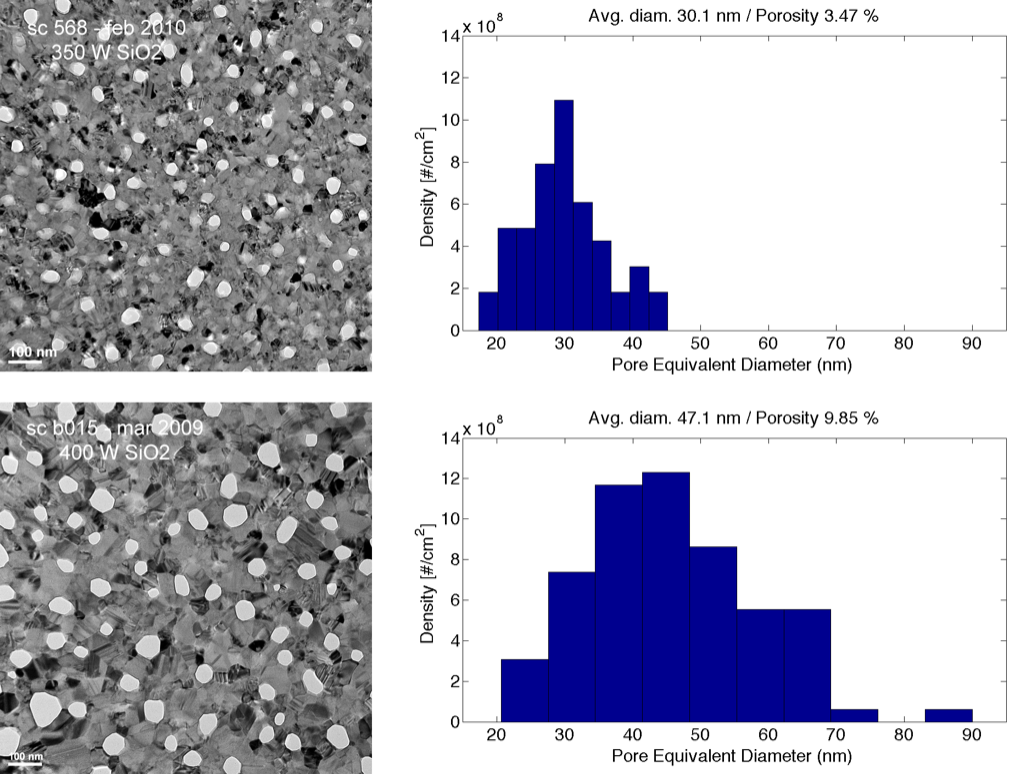
The biggest difference between the recent membranes and those made a year ago is the SiO2 deposition power. We dropped the power from 400 W to 350 W over the summer because we were concerned with arcing in the targets. With a higher power, the flux of sputtered atoms is greater and the effect of the substrate bias is effectively reduced. Since we believe pore formation begins at the Si/SiO2 interface, the stress in the oxide may be a very important parameter in controlling morphology as evidenced in the above images.
In the next production cycle, we will focus on varying the substrate bias in the oxide layer in order to tune the stress.
We will need measure stress to adequately determine how it relates to changes in morphology.
This is the very effect I proposed in my senior design.