
EO: Carbonized Membranes, Heating
This is a short review of a few experiments that Tom had set up this morning.
Carbonized membranes: A few carbonized membranes that were used for permeability measurements were tested in EO. The membranes were left in the sepcon, which was filled and placed in a reservoir. Electrodes went inside the sepcon and the reservoir. The system was run at the usual 15V (9mA), but almost immediately obvious bubbles formed at the surface of the membrane. After a few minutes the bubbles became numerous and blocked the membrane, forcing the current to zero. This does not happen with normal membranes, and it is unclear what gas is forming at the membrane surface (CO2?) and what is causing this process (field, pH, heating?).
Heating: We tested a non carbonized membrane in sepcon format to verify that bubbles do not form at the surface. Because of ease of viewing the intact slits, we raised the voltage in an attempt to view rupture at high voltage. Around 45-50V we noticed a knocking noise and viewed bubbles forming and popping near the base of the sepcon. It appeared that the solution was boiling near the membrane. We turned off the voltage and measured the temperature. Initially the inner chamber was 114F and the outer was 98F. For a longer time period at 50V (30mA), we saw the inner chamber go up to 166F. We then saw a current spike, which is an indicator of membrane rupture. We don’t know what caused the membrane to break, but there’s a good chance it was the bubbles formed from the potentially boiling solution. Is this Joule heating due to the membrane resistance? The boiling was not occuring at the wire surface.
UPDATE:
I performed carbonization EO in the horizontal format for 60min w/ SC 168. Bubbles did not seem to occlude the membrane during the experiment. Here are the results:
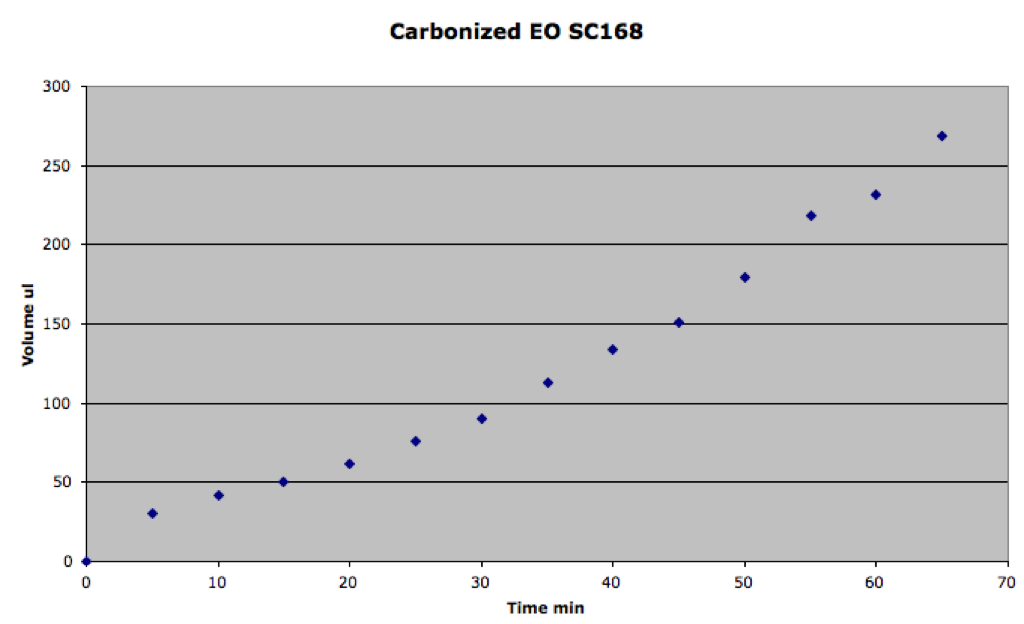
Setting a trendline to the 30-60 min segment (this post makes it seem like EO needs some time to equilibrate, 30 min may be enough) gives us a rate of 5.1 ul/min. This is slower than the non-carbonized samples from this set of wafers (although I do not have non-carbonized SC 168 data right now). From this data I would guess that there still a fair amount of charge on the carbonized membranes, or at least for this amount of carbonization. TEMs haven’t been looked at yet.
Hmmm. There are a bunch of things that come to mind. I doubt any funny chemistry is happening in the carbonized membranes, as they should be more inert than Si. I suspect you are kinda boiling the fluid, but I don’t know if it is just heating. As you accelerate fluid through the nanopores, there must be pressure differentials at the micro/nano scale that could promote vaporization. There may also be some breakdown effects at high e-field that could come into play. The key difference that I see is that the Carbonized membranes are probably more insulating, so whatever current you flow will be more focused within the pores, and the voltage drop at the membrane would therefore be higher (less drop in the bulk and nearby fluid). This will exaggerate all effects that you see. Do we know if EO or EP is dominating?
Heating over time makes sense. You are applying a lot of energy to a small volume, and energy is conserved, so it has to heat up. It would be interesting to know if the energy comsumed by electrolysis is significant, or whether it’s nearly all heat. Could you do some quick calorimetry calculations to figure out how much heat was added and compare that to the electric energy consumed? (It takes a calorie to heat 1 mL by 1 degC, as I recall, and the electic Power = Voltage*Current, and then just mulitply by time to get energy and compare after converting units.)