
Oxidized membranes in electrophoretic cell
I oxidized 2 intact chips from w639 using the following protocol: 10min with secondary generator, 15min with both primary and secondary generators. This protocol is slightly different than my normal protocol (10min 2nd, 5min 1st+2nd, 10min 2nd) because I messed up the settings, although the current protocol is arbitrary anyhow since we haven’t tested it more.
I inserted the chips into the cell. The first sample started leaking, but the second sample was good. I then measured the time required to pass 50 and 100 uL. It appears that the oxidized membranes are much faster than non-oxidized intact samples.
When I was through with this test I tried to use the system to separate cytochrome c, and while water still passed to the negative electrode, I didn’t notice any color change to the filtrate.
Here’s a chart comparing the oxidized samples to a couple of the previous trials.
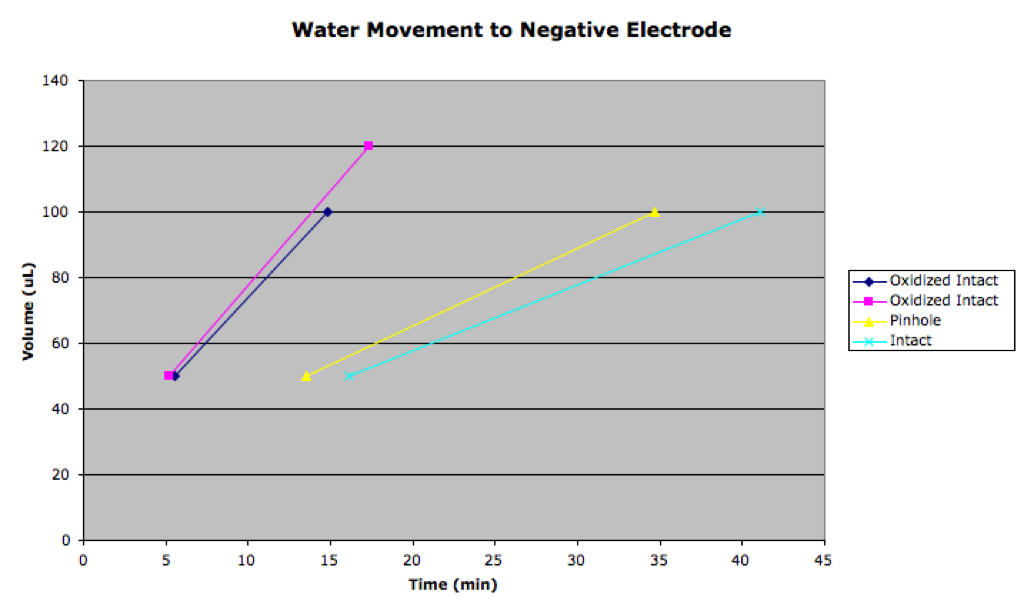
This is getting awfully close to proving that this is electroosmosis. If so, it is actually a way for us to investigate surface charge within the pores. Some day, when we have a vapor silanization tool, this opens up a lot of potential research projects.
I guess if we can invert the surface charge and show flow in the opposite direction, it would be a very strong case. IF we can make some stronger membranes, we can try amino silanization..
These results are very interesting…
Great work!
One concern I have now is… protein. Like Chris said, changing the charge of the membrane will change the direction. What if a protein adsorbs that has amine (+) groups facing the inside of the pore? Will the flow slow then reverse as pore walls become covered with positive groups?
I guess we will need to functionalize the surface with a charged group that also repels protein or other deposits – should be doable, right?
Physically, I’m not sure adsorption could reverse the flow, but it could stop it by screening the surface potential. Of course, given the flow and field within a pore, I doubt anything could adsorb to the wall.
I’m more concerned with cake formation, given the low porosity of our films. I suppose stirring can help, and at least it’s only one side…