
Desalting with Intact Membranes: Continued
As mentioned previously intact membranes show a flux comparable to membranes with pinholes during desalting experiments. To confirm this a third intact membrane test and two pinholed tests were run under the exact same conditions. Previous pinholed samples had different NaCl solution volume in the SepCon, I wanted to remove any variability caused by this. Intact SepCons trials 1 and 2 are single slit 100um by 1000um from W565, intact SepCons trial 3 is a double slit from W612, and the pinholed samples are from W615. It should be noted that pinhole trial 4 had 3 small pinholes and pinhole trial 5 had 10 small pinholes.
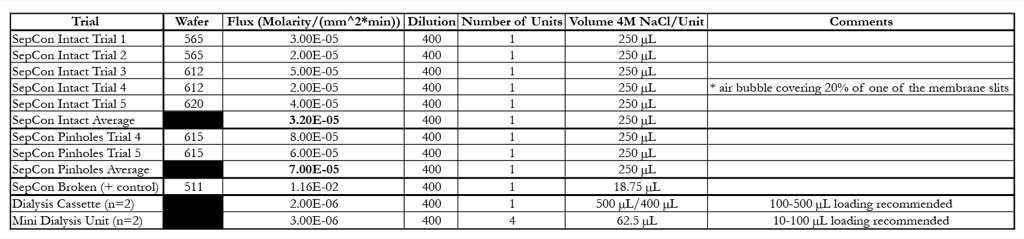
From this table it seems that the flux through pinholed membranes is two times greater than through intact membranes. Furthermore intact membranes have an order of magnitude greater flux than the cellulose dialysis membranes. I should point out that trial 3 with the intact SepCon shows a greater flux than trials 1 and 2, this could be explained by the difference in pore size and permeability we have seen with wafers 565 (had no air permeability but allowed rhodamine to diffuse) and 612 (had air permeability). I plan on running one more trial with an intact sample from W612 to see if this difference is real.
How much protein leakage can we tolerate for this application? Does the cellulose membrane show any protein loss through it? Obviously, if we use membranes with big, open pores, flux will likely increase, but we need to balance this with the need to hold in protein…
I have updated the table to include wafer numbers, all intact tests (I ran another today), and commercial results.
Table changed, had mislabeled SepCon Intact Trial 5 as from W612, in fact it was from W620.