Constant Current Electroosmosis
The new electroosmosis wafers have randomly distributed chips with 1, 3, 6, or 9 .1x.1mm freestanding pnc-Si squares. The idea is that we can use these to get a better EO rate vs. active area curve. SC125 seemed to have some sort of film on it, but I decided to give it a shot anyhow since there were a lot of chips without pinholes.
All of these experiments were run using constant current (set at 5mA) in order to solve for zeta potentials and fields using the alternative form of the Smoluchowski equation. In order to more accurately measure the volume flowing throught the membrane, I’ve positioned a pipette about the well with a lab stand and I am weighing the fluid I pull of at intervals. All experiments are now being performed in .1mM KCl instead of PBS. Here are the results from the first few experiments:
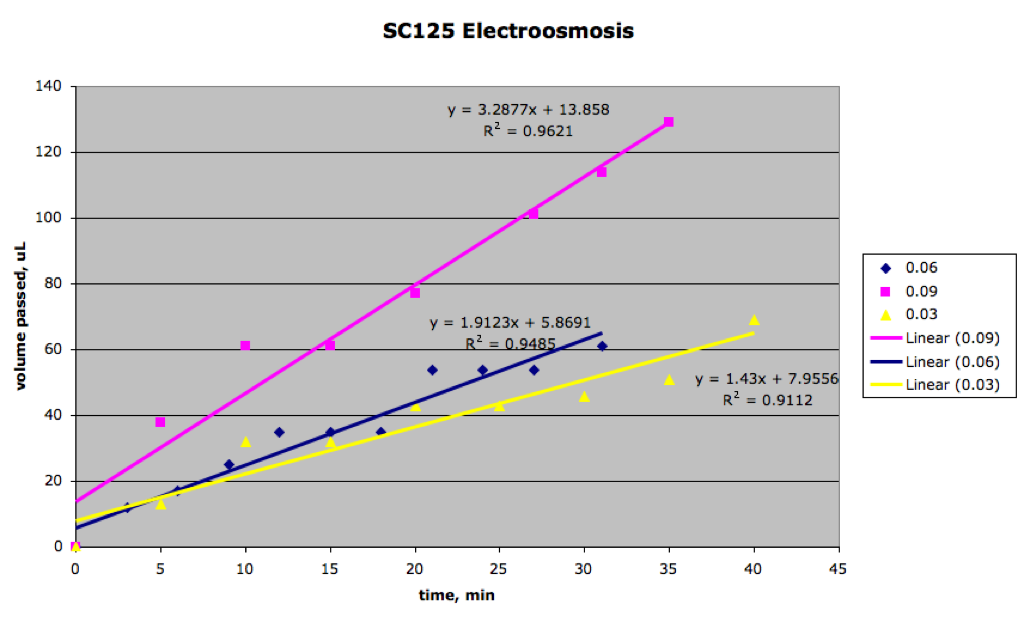
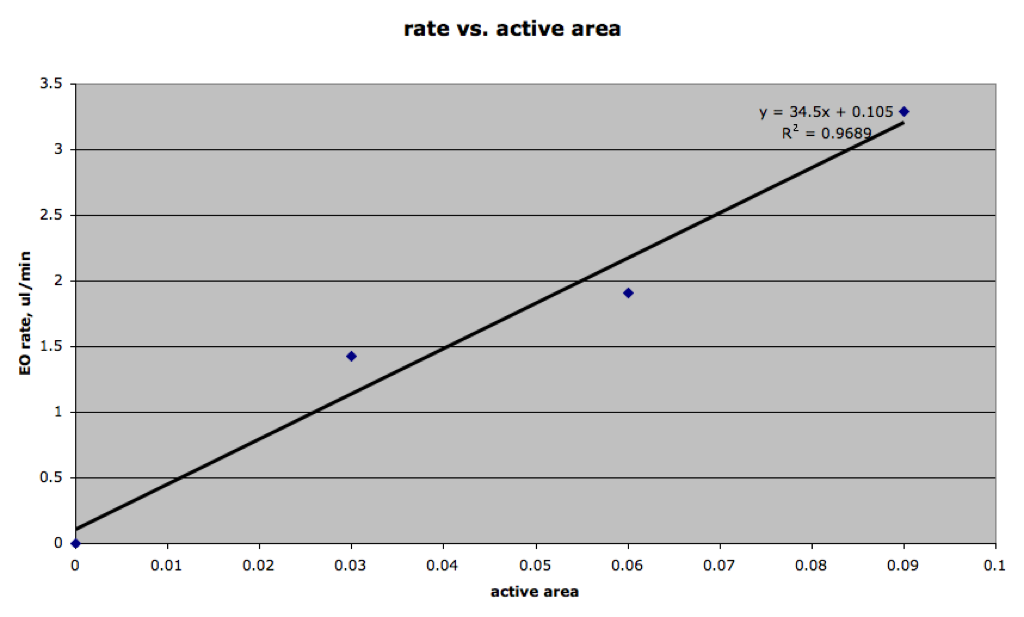
Here we have 3 experiments, each with a different chip represented by its active area (in mm2). The smallest active area chip (.01mm2) popped when I brough the voltage up too high. There was no discoloration and no pressure, but perhaps the high field or a bubble causes the breakage. I have then used the slope of the trendlines to plot the following rate vs. active area curve:
It turns out though that while all of these experiments were run at 5mA, the running voltages changed in response to the amount of active area (I guess you can think of the membrane as a dielectric). Here is a voltage normalized plot of the rate vs. active area (the voltages were fairly constant for all cases):
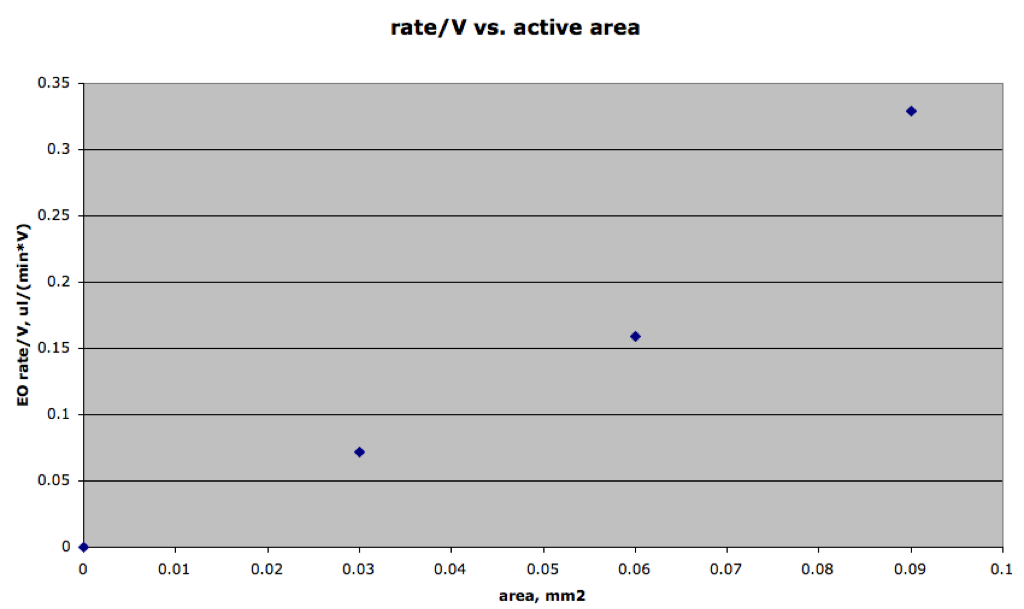
This version looks like it could be even a little exponential. It’s hard to say with only one experiment each though.
I think I’m pretty satisfied with this method, and I will continue to run some more repeats.
The membranes are just behaving like resistors, so if you change the area, but keep the current constant, the voltage has to change. I would suggest keeping the same voltage for each membrane, so the dynamics are the same, but run in constant current mode during your experiments. Basically, you would just be scaling your current value to compensate for resistive effects to maintain the same voltage drop. Letting the area dictate voltage, probably complicates the interpretation.