
Dilution Problem
This was mentioned in the meeting today, and I’ll try to describe what’s going on here.
We start out with a system with a smaller volume on the top of the membrane:

If we start out with 10 mg/mL in the retentate, and assume perfect equilibrium of the protein/particle:
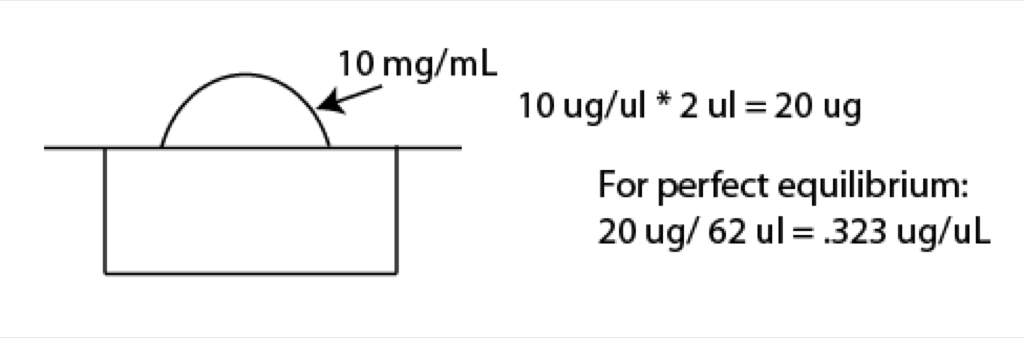
The concentrations in each compartment would be the same, but due to the difference in volumes the mass in each compartment would be:
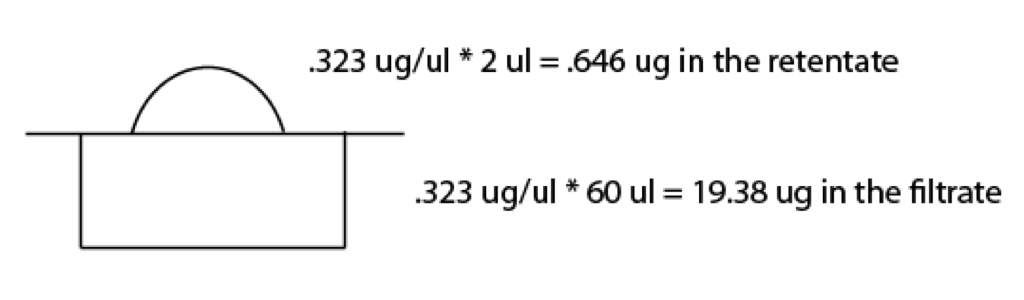
And if we dilute the top so that it is the same volume as the bottom and run the samples on a gel, the resulting concentrations would be:
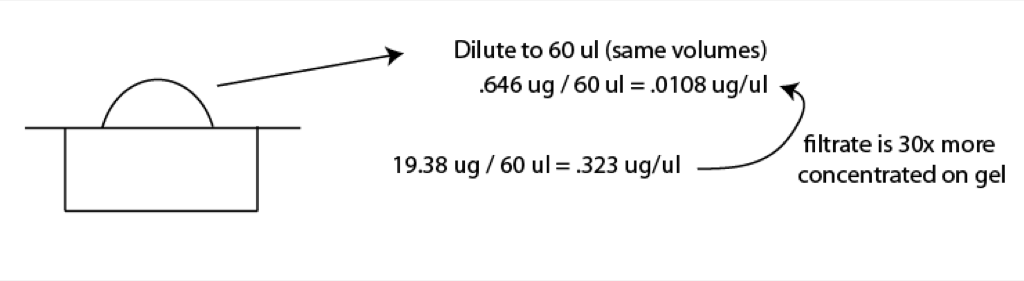
and you would expect a 30x darker filtrate band than the retentate (assuming you pipette the same volumes into each lane of the gel).
Has anyone looked at the diffusion problem that we discussed in this geometry? I’ve always considered reaching equilibrium in 24 hours to be quite fast for any larger molecule in an unstirred environment. Given the cm-scale transport distances and the 2 tiny slits connecting the chambers, intuition tells me that more than simple diffusion is happening in the open solution. A simulation would probably be required to model this exactly, but what about a back of the envelope calculation using the diffusion coefficients of molecules with a range of sizes? Is 24 hours close to being reasonable?
Good question.
Let’s use the first passage time equation. Basically this gives you the average time required for a molecule to diffuse a certain distance without external forces. This equation is for a one dimensional system.
t = x^2/2D
If I solve for t and use .5cm as our x distance (this is about the chamber dimensions, but the actual distance may be less if you just want the molecule to go across the membrane). We’ll assume a 100 kDa protein, which has a diffusion coefficient (D) of 67 um^2/s.
This gives 1.8 * 10^5 s, or about 2.2 days for a 100 kDa protein to travels .5cm in the absence of forces.
Once a protein gets to the membrane, it should be immediately diluted in the backside. That means we may only need to worry about the protein diffusing half of that distance.
This is a good starting point. Now this calculation probably has some type of exponential time constant, so would that 2.2 days be the time required ~63% of the molecules in a population to travel that distance? Depending on your definition of equilibrium, it may be 3X that time (assuming 95% is close enough)? Please correct me if I misunderstand the equation.
Also, this is the 1-D problem, so it’s kind of like having a membrane across the entire bottom of a tube, filled to 0.5cm with solution. If we then limit that membrane to a tiny orifice at the bottom of that tube, it strikes me that the process would be slowed, as the random walk would tend to get delayed in the side areas as molecules need to “search” for the open membrane.
Given these effects, do you think we have some natural convective mixing in the open solution? Of course, the species that we have observed approaching equilibrium are typically smaller than 100 kDa, so would diffuse faster.