
Co-localization Analysis of CD81 Labeled 5637 EVs
Now that I am working on labeling my 5637 EVs, I have finally gotten around to getting a good labeled sample and a good negative control. The samples were prepared as follows:
5637 EVs were thawed from a frozen stock and 1 μL was diluted into 1 mL of labeling fluid. The labeling fluid contained either 2 μL of CFSE and 2 μg of 2500 x g cleared CD81 AF647 or 2 μL of CFSE and 2 μg of STAR RED secondary antibody with the balance being PBS at pH 7.2. The prepared solution was incubated at 37 °C for 2 hours on a rotating mixer. It was then removed and prefiltered using 0.5 μm slit membranes in SepCons with a brief spin at 500 x g. Then, 10 μL of the filtered solution was diluted into 1 mL of PBS at pH 7.2 to give a final dilution of 1:10,000 from stock for the EVs.
These samples were then captured on the membrane in TFAC and imaged in the confocal microscope.

Figure 1: CD81 labeled 5637 EVs captured by TFAC.
Figure 2: STAR RED negative control for 5637 EVs.
The resolution of the confocal system allows us to look at the labeled vesicles at high magnification and we can observe individual vesicles labeled with both CFSE and CD81. The STAR RED was a secondary only label and ideal there is no receptor for the antibody to bind to, which would only give us non-specific binding of the secondary. To determine if the antibodies are actually labeled by CD81, I performed a co-localization analysis on some regions of the membrane. To do this, I used a plugin for ImageJ called ComDet (https://imagej.net/Spots_colocalization_(ComDet)) which is designed to co-localize particles in an image. The output of the analysis generated a map of identified particles including co-localized particles boxed in yellow (Figures 3 and 4).

Figure 3: Particles identified in co-localization analysis of CD81 labeled 5637 EVs.

Figure 4: Particles identified in co-localization analysis of STAR RED labeled 5637 EVs.
This plugin produced data defining the association of the particles and the antibody labels. The localization can be described as follows: The total number of particles of each channel were identified. The software then identified the number of particles that were co-localized (within a region of 4 pixels). It then took the total number of co-localized particles and divided it into the total number of particles for each channel. This resulted in the outputs of: 1) CD81/STAR RED antibodies that are co-localized with CFSE labeled EVs and 2) EVs labeled with CD81/STAR RED. The number of interest to us is the amount of label that is associated with the vesicles. The reason for this is because we know that not all EVs will label with CD81, so the labeled percentage is not as important.
The percentage of CD81 and STAR RED associated with vesicles is shown in Figure 5.
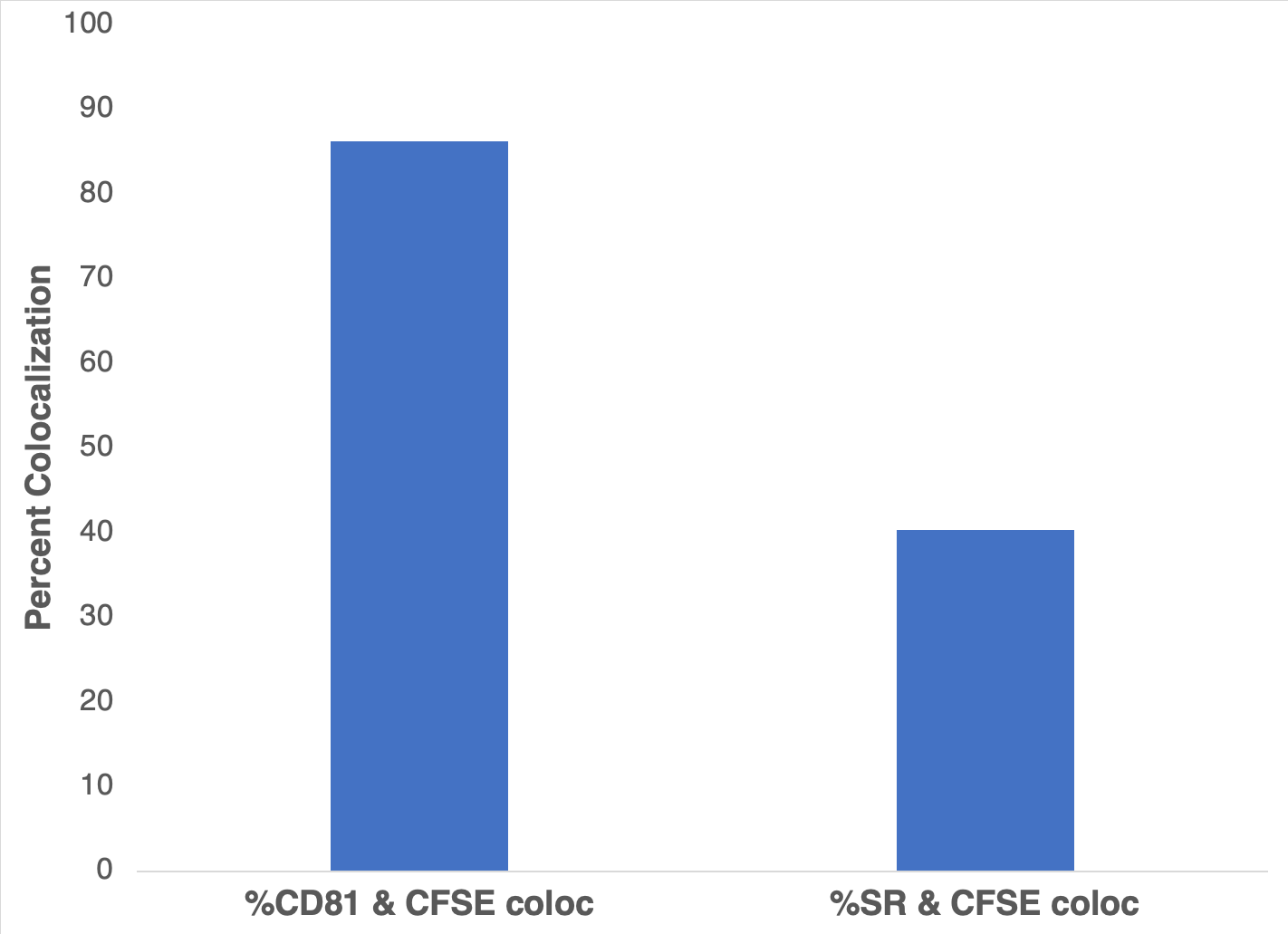
Figure 5: Percentage of co-localized antibody and EVs.
This analysis shows that while there is non-specific binding of the secondary antibody, there is a much higher percentage of EVs labeled with CD81, suggesting that the samples label very well.