Parylene microporous membranes
I am developing a process for fabricating microporous Parylene Liftoff membranes. I am interested in these as a more flexible substrate for cell culturing. Parylene is relatively strong (compared to say pdms), so it is feasible to work with lifted off pieces of membranes on the order of 1 micron or less in thickness. I list a couple references below with some comments. It seems that the preferred manner of patterning small features on Parylene is with a metal hard mask, but it is possible to pattern micro-scale features in membranes ~1 micron or less thick using just a resin-based resist.
I deposited 850 nm of Parylene on wafers that I had previously coated with dilute Micro-90. The Micro 90 is a release agent that is used in the Parylene chamber to allow one to peel off the excess Parylene. It is basically a soap that dissolves in water. I think it would be possible to get membrane release without the Micro 90 and will test this in the future. Next, I coated them with Shipley 1813 and patterned that with the high porosity 3 micron pores. I etched using an oxygen plasma RIE in the Drytek Quad (50 sccm O2, 150 mTorr, 150 W). The etch also removes the photoresist, so the etch time has to be optimized. I found that the Parylene etches at about 600 nm/min. I tried etching witness samples for 60, 75, and 90 sec. It seemed that the pores were not completely through the Parylene until etching for 90 s. Below are some snapshots of a lifted off piece. It is very easy to remove by simply dripping water on the surface and peeling from an edge with tweezers. I first rinsed with acetone to dissolve any remaining resist.

Aslan kindly obtained some SEM images (shown below) that show that the pores are etched through the membrane.

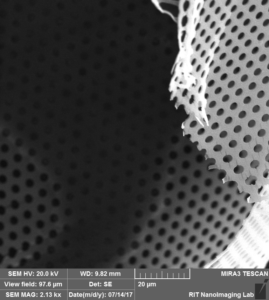
SEM micrographs of the membrane. The membrane was intentionally folded so that both sides could be imaged to verify that the pores were etched all the way through.
Next steps:
I plan to make a 24-well insert fixture that can hold the lifted off membrane – possibly with a thin layer of Sylgard. I’ll work with Tom and Stephanie to see what cell culture experiments make sense.
Literature Summary:
Topographical Patterning of Chemically Sensitive Biological Materials Using a Polymer-Based Dry Lift Off, Ilic, B;Craighead, H G, Biomedical Microdevices; Dec 2000; 2, 4; ProQuest pg. 317)
They simply applied positive resist directly to 1 µm thick Parylene-C using HDMS and etched with O2 plasma. They were able to get trenches on order of 2 µm wide. They also got lift off of Parylene film starting with clean wafers (piranha-cleaned), but they were peeling from diced wafer samples using scotch tape at the corner to start the lift off. It also sounds like they were able to lift off the parylene films without any secondary scaffold.
Microfabrication of high-resolution porous membranes for cell culture, Monica Y. Kim, David J. Li, Long K. Pham, Brandon G. Wong, Elliot E. Hui, Journal of Membrane Science 452 (2014) 460–469.
Need to create hard mask for RIE of parylene since plasma O2 will etch through photoresist. They used Ti from e-beam (100 nm). They used a 1 µm thick parylene-HT. Parylene etching was accomplished by reactive ion etching (Mini- lock-Phantom II, Trion Technology). First, the Ti hard mask was etched using 45 sccm of tetrafluoromethane (CF4) with 2 sccm of oxygen for 180 s at a pressure of 6.7 Pa and 100 W of power. Next, 50 sccm of O2 was flowed for 60 s to purge residual CF4 from the chamber. Finally, the Parylene was etched using 50 sccm O2 at 20 Pa and 100 W for 120 s. The photoresist is etched away during the oxygen plasma etch. Finally, notebook reinforcement labels were applied to each membrane to support the membranes for LO. After LO, the membranes were dipped in 0.5% HF to remove the remaining Ti hard mask. Membranes were rinsed 3 times in DI water after the HF etch and then air-dried.
They also give details of cell culturing on the membranes. They superglue glue the membranes to multiwell plate inserts after removing the commercial membranes. After sterilization and rinsing with DI water they treated with 200 ml of 5 mg/ml human fibronectin (Gibco) in 1 phosphate buffered saline (PBS) for 3h at 37 °C. Excess fibronectin was aspirated and membranes were rinsed once with sterile 1x PBS.
Surface Engineering and Patterning Using Parylene for Biological Applications, Tan & Craighead, Materials 2010, 3, 1803-1832
Nanoscale Resolution, Multicomponent Biomolecular Arrays Generated By Aligned Printing With Parylene Peel-Off, Tan, C.P.; Cipriany, B.R.; Lin, D.M.; Craighead, H.G., Nano Lett. 2010, DOI: 10.1021/nl903968s.
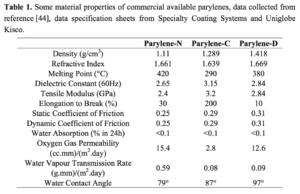
They give a nice table of data for three Parylenes (see below). They were able to create pores in their stencil with ø90 nm. They settled on 400 nm thick Parylene and used a 15 nm Al mask and e-beam litho to get the 90 nm features.
Bob: seen anything as thick as 12 µm in your reading on paralene?