
Burst Pressure Test
Introduction
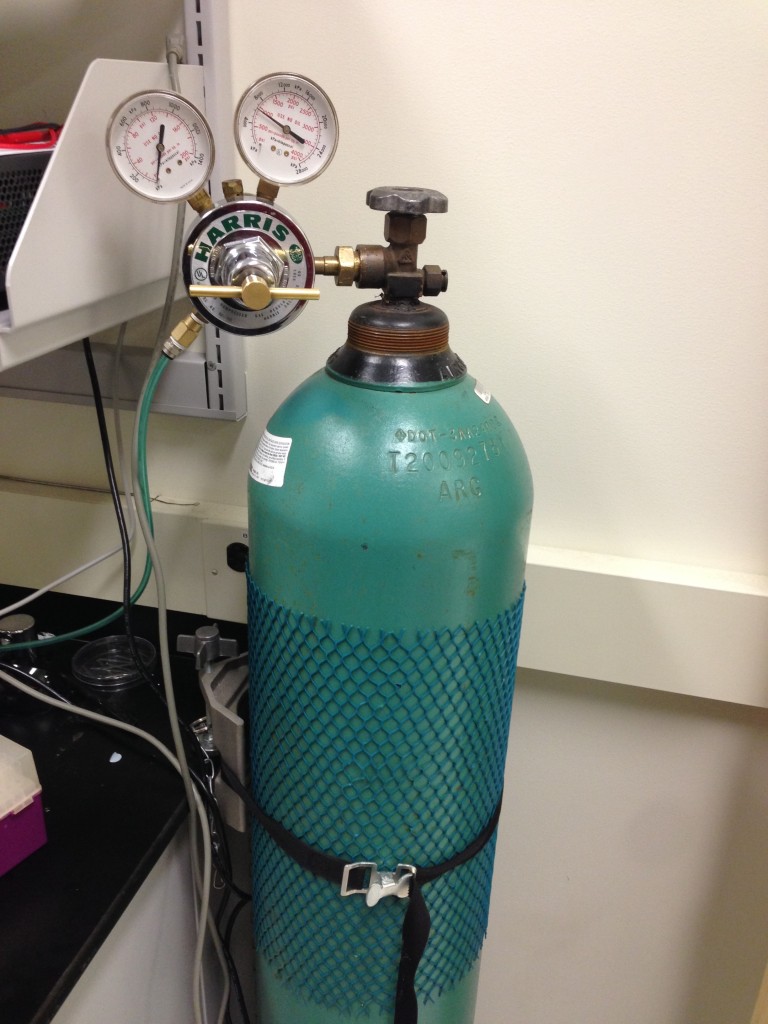
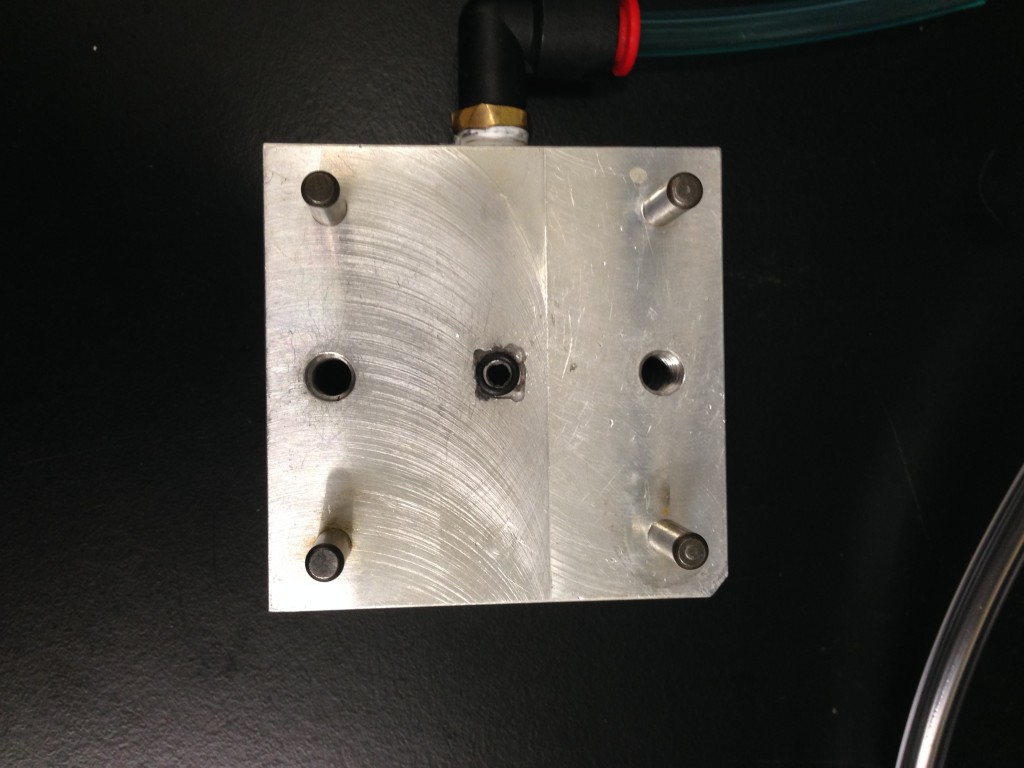
After completing my experiments on burst pressure of HD membranes, I started the experiments on finding the burst pressure of 3-channel nitrite chips by using the airgas cylinder. This experiment is to investigate if soaking in viscous fluid will significantly weaken the membrane and lead to burst. The chip was placed on the center of the fixture, where a drilled hole was connected to the pressure valve. When I increased the pressure coming out from the airgas cylinder, the pressure on the membrane went up until it burst. The maximum pressures were recorded by a barometer.
Method
| Control | fresh chips | ||
| Soaked with PBS | after 4 hrs | after 24 hrs | after 48 hrs |
| Soaked with FBS | after 1 hr | after 2 hrs | after 4 hrs |
As shown in the table above, three groups of chips were tested. Fresh chips that were not soaked in any solution were tested as the control group (n=5). Chips soaked in PBS for 4 hours, 24 hours, 48 hours and those soaked with FBS for 1 hour, 2 hours and 4 hours were also tested (n=5).
Before soaking them in PBS or FBS, the chips were rinsed with DI water, and then dried with kimswipes. 10X PBS was first diluted to 1X before it was used to submerse the chips.
After removing the chips out of the solution, they were again rinsed with DI water and air dried before testing.
Results & Discussion
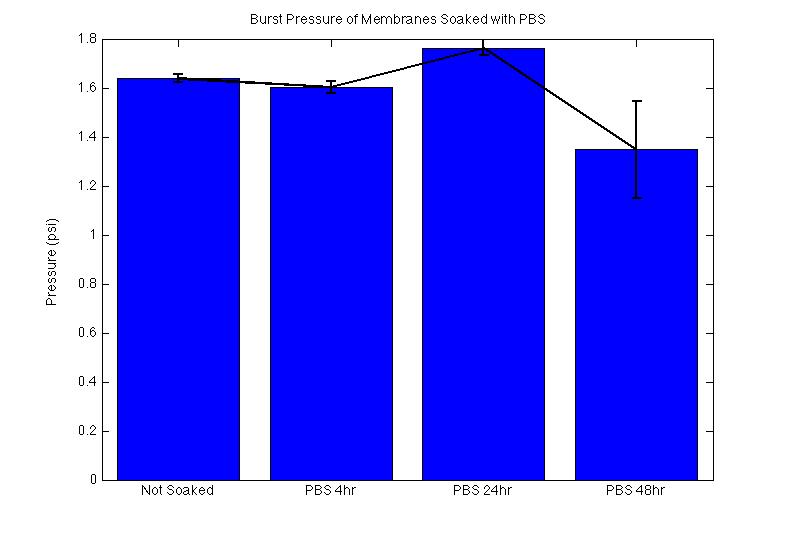
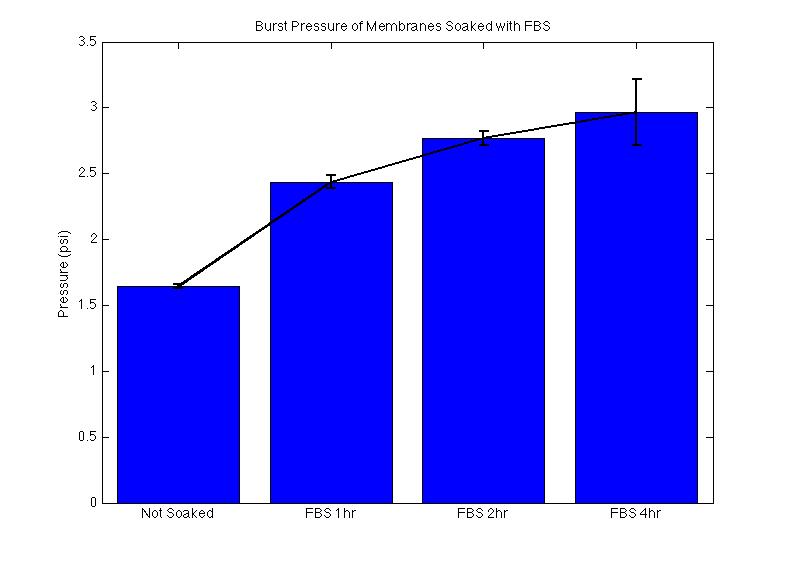
When compared to burst pressure of chips that were not soaked, that of the chips soaked in PBS is not significantly different. Those soaked in FBS, however, showed an increasing trend as chips were soaked for longer time. This result is inconsistent with our hypothesis that the viscous fluid will weaken the membrane and thus lower the burst pressure. My assumption will be that molecules such as albumin in FBS were able to deposit on the membrane after soaked for a while and let air dried, and hence higher mechanical strength of the membrane.
Since some membranes broke before tested, the sample size is relatively small to draw a conclusion. More chips should be used to yield more precise results.
It’s great that PBS exposure is not changing the BP because the SiN membranes should not interact at all with this solution. When degradation has been seen in the past , it’s always been unclear why this decay would occur.
For the FBS, any dried organic material like this would not be very strong relative to the SiN, so it seems unlikely that it could strengthen the bulk membrane itself. However, if your process for rinsing and drying left a substantial network of denatured protein at the backside of the membrane near the edge where it connects to the wafer, it may provide some support to this region where the breakage typically begins. Did you happen to inspect these samples under a descent optical microscope with contrast enhancements like DIC? Thick protein deposits would look like gradients of different colorations. You could also test this by replacing the DI rinse with something that could remove bound protein like a detergent/PBS solution – tween 20 or SDS, or whatever other people have found effective at cleaning protein off the chips. If the increase strength goes away, then you could tie this effect to the bound protein.
Thanks for posting!