
TEER Testing BBB Device v2.4 with Shrink Wrap and Media
After some changes to my fabrication process, I can report a qualified successful TEER test with media (HBSS) in both channels. I utilized a shrink wrap method of fabrication as seen in a previous post. The test was not perfect because I ruptured the channel while moving the fabricated device to a microscope slide. Also, there was not continuous flow from one end of the channel to the other. However, there wasn’t any leaking around the contact pads that had previously caused my TEER measurements to “short”; the channel was full of fluid, but not anywhere else electrically important.
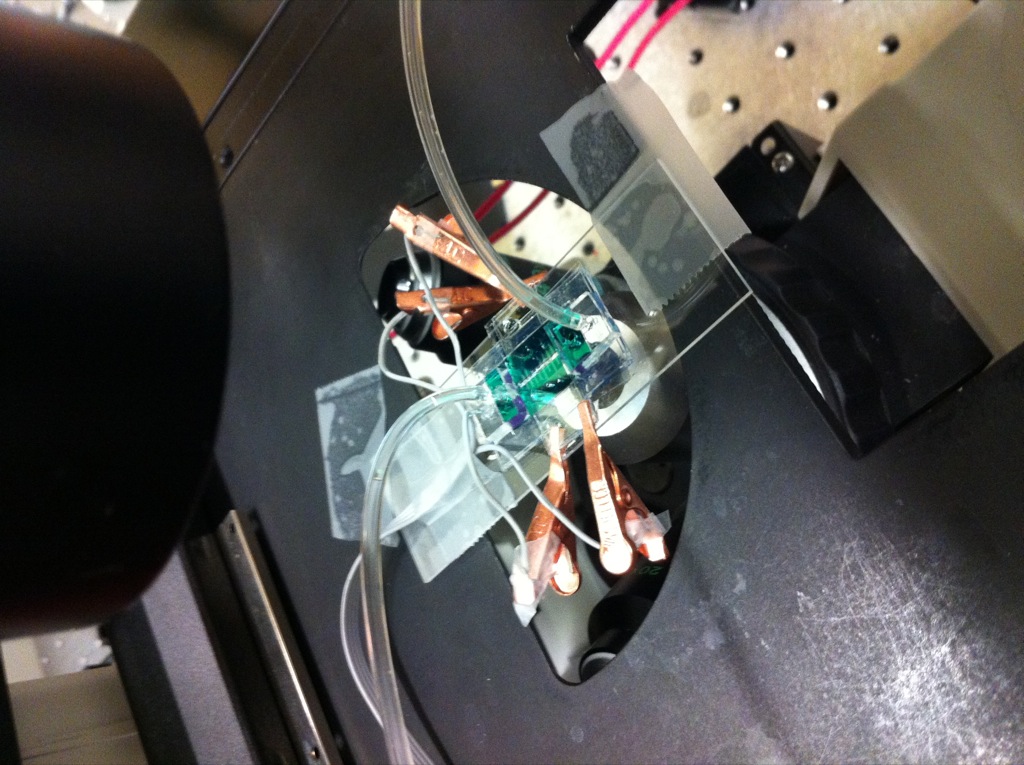
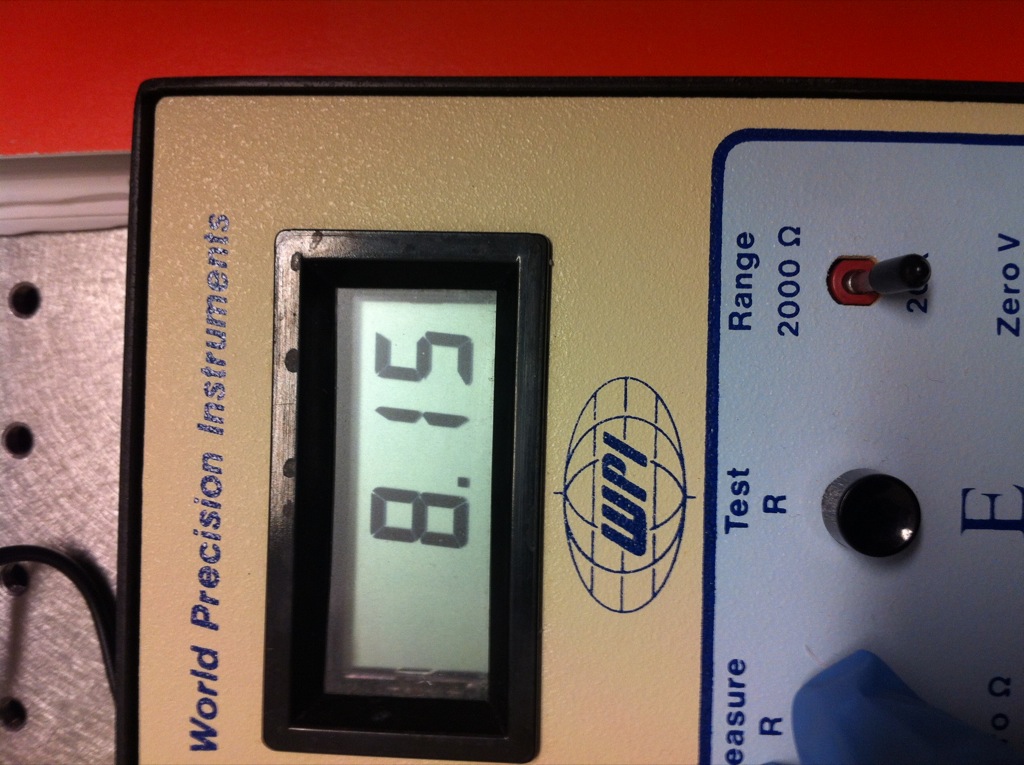
I did not notice the large cyclical resistance swings (+/- 3 kohms) as previously noted. The measurement did drift on the order of 100s of ohms when I measured repeatedly. As expected, the HBSS has high conductivity. Thus, the only things contributing to the measured resistance should be the geometry of the device and the resistance of the electrode materials. The remaining measurement drift is still unexplained. I would expect a steady state measurement, even with the parallel wire capacitance at work. Could there be a net drift of ions in the HBSS media, even as AC current is applied?
Each individual device will need to have a background resistance measured before seeding cells in order to establish the resistance baseline. I believe that this should include the fibronectin scaffold coated onto the membrane, because its’ presence should lower the conductivity of the membrane by blocking some pores. Even with these variables, I expect there to be a narrow range of resistance for each device. Lowering the background resistance is important, as the signal to noise ratio will improve.
As previously mentioned, I’ve tried a shrink wrap method to fabricate my device as seen in a previous post. It worked better in bringing the individual layers into contact, but it has not been completely sufficient, as new leaks have sprung up to replace the ones I have fixed in the attempted devices. A leak occured around the filter interstitial gasket filter, traveling around the perimeter of the silicon chip.