
AFM of amorphous Si follow-up
Using fresh tips, I re-ran the scans of amorphous Si films deposited at different biases. Recall that our theory states that interface roughness between the Si/SiO2 is an important determinant for ultimate pore morphology. A rough interface will suppress nucleation, which is why we observe low porosity with zero bias. The 05 W condition decreases the interface roughness while maintaining a critical level of point defects in the Si, which nucleates pore growth. High bias maintains the smooth interface, but reduces the point defects. Consequently the pore density decreases sharply at substrate biases > 8 W.
The samples below were deposited as a three layer (SiO2/Si/SiO2) stack and then had the top oxide stripped prior to scanning.
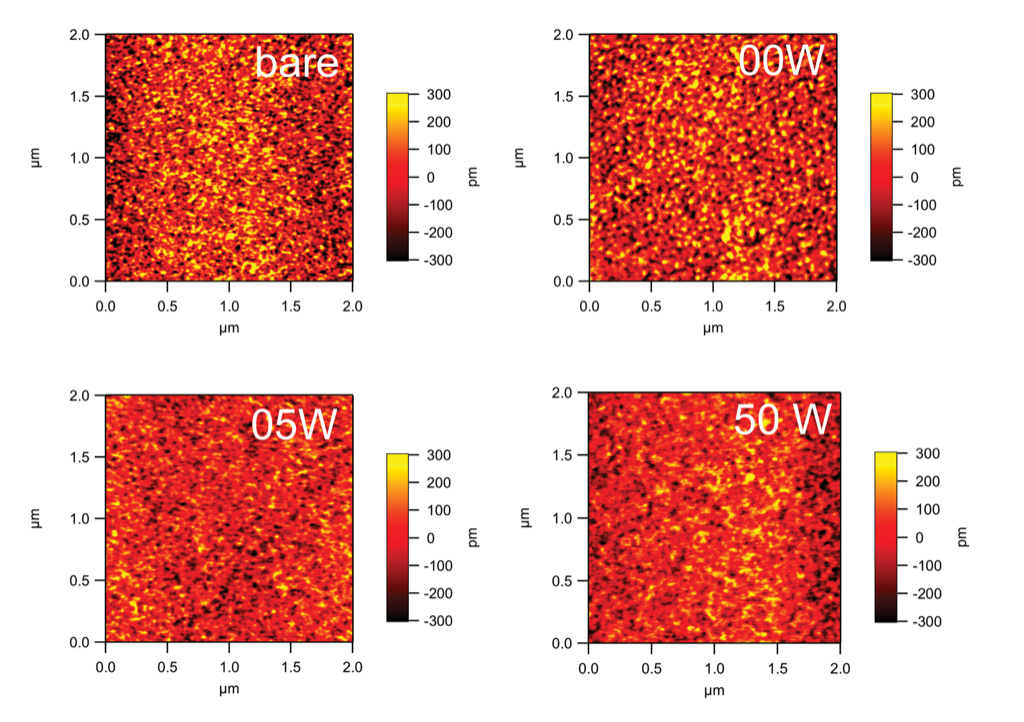
The bare wafer and 00 W substrate bias sample show similar RMS roughness values of 1.3 A. The 05 W and 50 W films have RMS values of 1.0 A. This confirms our hypothesis that substrate bias smooths the interface.
I also took a look at supported pnc-Si with the AFM. Below is a comparison of imaging with a dull (top) versus sharp tip (bottom).
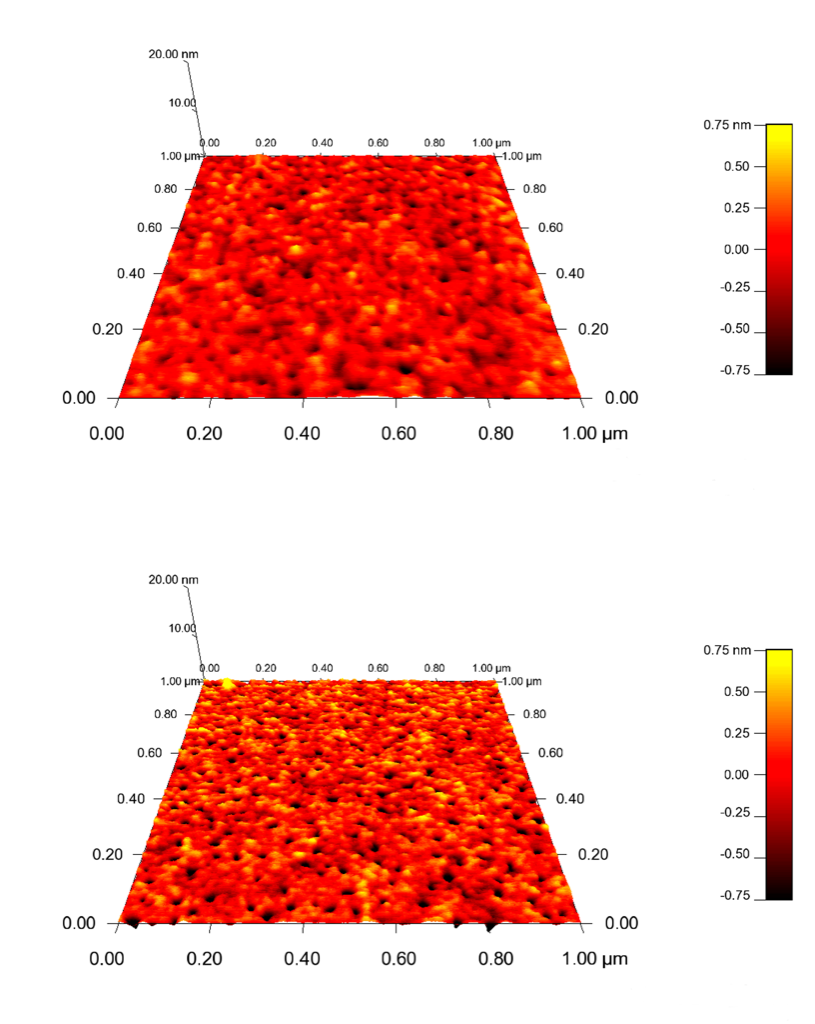
In my recent post of AFM scans of alumina coated pnc-Si, the control sample (bare pnc-Si) looked anomalous. This was probably caused by imaging with a dull tip…
This data is quite interesting. Can you plot the a-Si film next to the crystallized porous film, so we can compare roughness on the same scale? I curious if we can quantify how much roughness increases following crystallization.
It also strikes me that the top surface appear to have some conical-like entrance features on the pores. Does this confirm Maryna’s SEM data? I suspect that the bottom side is far sharper, so it would be interesting to get a scan of the other side. This asymmetry may provide some support for a theory about why why the asymmetric oxide thicknesses are affecting the pore size and distribution.
Hi all, I’m still around. Nice scans Dave – I have a couple comments/questions:
Have you looked at multiple regions of interest on the same substrate? These are only 2×2 um scans, so it would be nice to have the roughness of different areas on the same substrate before making conclusions about such subtle differences in RMS roughness.
Were the scanning parameters (gain, etc.) about the same in the new vs. dull tip comparison? I’m wondering if you were tapping the surface with about the same force. There’s a protocol in the manual about how to adjust the set point with the hamster wheel – that’s what I found to give me the most consistent results.
Keep in mind that these tips are conical so as they fall into pores/holes on the surface, there will be a conical artifact at the edges of pores/trenches. Of course, the size of this artifact will be related to the sharpness of the tip. I’m not sure if the tip could be blamed for it here, or not.
Chris, I’m trying to figure out how to plot the data on the same scale using the AFM acquisition software. I may end up performing a fresh scan since the resolution will be different if I just scale the images.
Barrett, I do need to confirm that the RMS measurements with the small ROI is representative of the entire film.
I haven’t read the manual, but I usually set the target amp. to 1 V and applied force to the lowest possible setting such that the phase is stable. I’ll check out the manual for tips on optimizing the scanning parameters.
I’m hoping the AFM scans will give us clues on how the silicon is “dewetting” from the oxide during crystallization. If we probe a large enough pore, hopefully the resolution of the tip will be good enough to capture some useful information.