
R61/R33 Update to NIH on Nov. 9, 2022
Attached is a PDF presented to the NIH at our annual update meeting that included other funded project teams.
Attached is a PDF presented to the NIH at our annual update meeting that included other funded project teams.
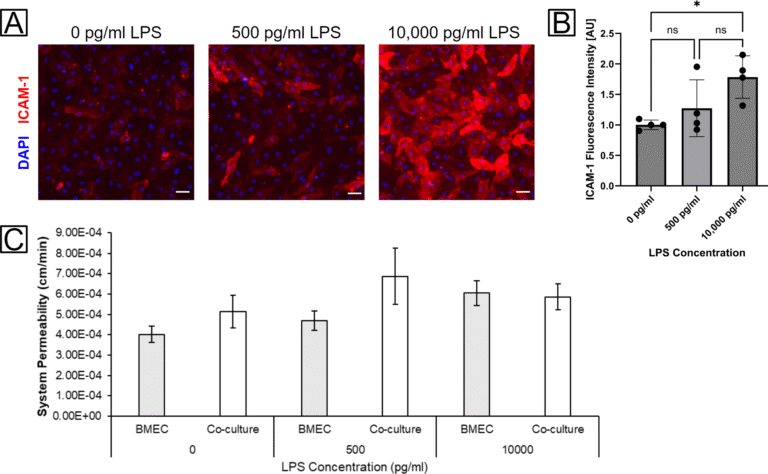
Introduction Sepsis refers to an uncontrolled systemic inflammatory response which can result from bacterial blood infections. We have long been interested in developing a sepsis model using the μSiM-BBB platform because the neuroinflammation stemming from sepsis can cause severe BBB disruption. For the majority of our stimulation experiments we have relied on cytomix, a cocktail…
Recently we have received dual scale (nanoporous and microporous) membranes from SiMPore at two porosities: 0.625% and 1.25%. These feature 3 µm circular pores (Lot 1383). We routinely perform QC checks on membrane deliveries, so the following is report on this delivery. First, I’d like to note that we were supposed to receive equal amounts…
Introduction In addition to in situ measurements of small molecule permeability (Parts 1, 2 and 3), we wish to enable an assessment of permeability by sampling from the abluminal chamber of the µSiM in a manner similar to what is done with Transwells®-style devices. To begin this, we need to review the methods used with…
Background Previously, we have demonstrated multiplexed digital sensing on MCP1, KC and TNFα secreted by RAW 264.7 cells stimulated in conventional cell culturing well plates. We observed decent TNFα and strong MCP1 response but no KC secretion from RAW cells upon 100ng/ml of LPS stimulation overnight. The work verified our platform’s capability of multiplex cytokine…
Introduction A recent collaborative publication from RIT developed a modular µSiM to address the lack of physiological fluid flow in conventional open-well devices (Figure 1). The magnetic latching assembly of this design allows for quick configuration into a fluidic setup. The flow module is a microfabricated PDMS insert that contains a channel over the membrane…
Background We at Michigan have been aiming to perform sequential small volume sampling coupled with our ultrasensitive digital immunoassay to provide longitudinal data from the uSIM. We have encountered repeatability problems as well as low molecule abundancy with shortly incubated samples collected from the bottom microfluidic channel. Therefore, COMSOL simulation work has been done to…