
Applied and Required Force Comparison of TE and NPN
Hello Everyone,
So i decided to do some calculations on our 2 different sets of experiments (Track Etched and NPN) and compare the applied and the required force of them, in addition to making sure that we are applying enough force on the particles to keep them captured. The experiment conditions for both TE and NPN are the same, we push the sample with 5 microliter/min and pull with 2 microliter/min.
- Calculating the pore resistance (Rp):
Using the thickness and the pore radius, the resistance of a single pore can be calculated (Equation 1);
(1) 
2. Calculating the membrane resistance:
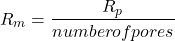
The membrane resistance can be calculated by dividing the single pore resistance by number of pores in the interaction area (Equation 2);
(2) 
3. Single pore flow rate:
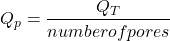
Simply by diving the total pulling flow rate (2 microliter/min) by the number of pores in the interaction area, we can calculate the flow rate in a single pore (Equation 3);
(3) 
4. Single pore pressure:
Multiplying the flow rate of a single pore with the resistance of a single pore, we’ll get the single pore pressure in equation 4 (Same concept as V=IR);
(4) 
Single pore applied pressure:
By dividing the single pore pressure with the single pore area, the applied pulling force on a single pore can be calculated (Equation 5);
(5) 
Kilean and I generated a model for captured particles on the force balance on the particle. Using this model, the shear force and the required suction force to hold a particle captured can be related by equation 6:
(6) 

Figure 1; Model for a captured particle
For Track Etched experiments (TE), the pore size of the membrane is 80 nm and particles are 100 nm, while for the NPN experiments, pore size of the membrane is 50 nm and particles are 100 nm.
We also know that shear force (F (d)) can be calculated using equation 7 where r is the particle radius and V is the average flow velocity;
(7) 
But it’s important to note that, particles are not experiencing the shear with the average velocity since they are close to the membrane (wall), therefore, in the above equation, instead of using the average velocity, the velocity on the particles needs to be used which can be calculated using the velocity profile equation 8 which is;
(8) ![\begin{equation*} \ V_x = V max . [ 1 - \frac {4y^2}{d^2}] \end{equation*}](https://trace-bmps.org/wp-content/ql-cache/quicklatex.com-1b39ad649e5ee664c7eb252a94627f00_l3.png "Rendered by QuickLaTeX.com")
Figure 2; Velocity Profile on

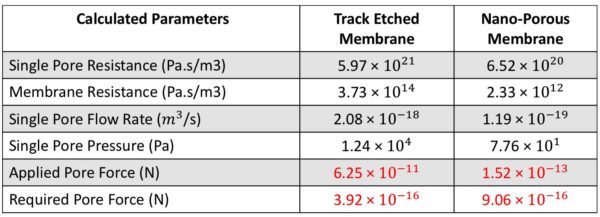
and then if we use the velocity in equation (8) for shear force, we’ll have the shear force applied on the particles. Therefore, using the equation from our model, required force to keep a particle captured (not shearing off with the shear force) can be calculated which can be seen in table 1. In addition, we can compare the applied force with the required force for each set of experiments showing that we are applying enough force to hold particles captured, we can also have an idea of how different are the applied and required forces on a single pore between TE and NPN experiments.
Hey fam, you might want to check out my post from February on this topic (https://trace-bmps.org/nanovesicle-rigidity-can-exosomes-be-modeled-as-rigid-particles/). I had to do a calculation for Rick to prove that exosomes can be modeled as rigid particles and he gave me a paper and some equations to go off of for this analysis. Basically, it’s a more robust model than we have and gives us values that are probably a bit more realistic I think. I was measuring something like 1e-9 – 1e-11 N, which is at least 5 orders of magnitude higher than what you found. I think that I estimated for a 50 nm pore, like I always do. Let me know what you think.