2017 Spring Meeting – Materials Research Society
Hello everyone, this post is a summary/recap of the MRS Spring meeting that was held in Phoenix, Arizona this past week (April 17 – 21). Here is an overview of two sessions:
Molecular and colloidal plasmonics – Synthesis and applications (ED14)
Jennifer S. Shumaker-Parry, Associate Professor at University of Utah (http://shumaker.chem.utah.edu/)
Combined top-down/bottom-up for the fabrication of nanostars to be applied as plasmonic antennae. Their process uses self-assembly of nanospheres as a close-packed arrangement that is used as shadow mask for the deposition of a metal. After removal of the nanospheres, the substrate with metallic triangular pattern is used as seed in a chemical synthesis to continue metallic growth. The process result in nanostars, triangles decorated with sharp needle-like features.
Robert Hughes,Research Associate Professor at University of Notre Dame (https://ame.nd.edu/research/faculty-research-labs/neretina)
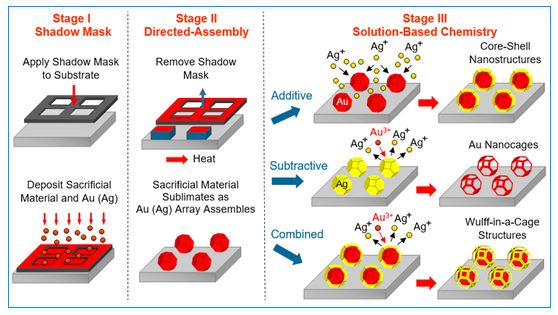
Dr. Hughes is part of a research group led by Dr. Svetlana Neretina, associate professor in the aerospace and mechanical engineering department. They combine nanoimprint with dewetting to form complex nanostrucutres like the ones in the figure below, for photovoltaic applications. This talk reminded me not to forget dewetting processes.
Amogha Tadimety, Graduate student at Dartmouth College (http://nanolitesystems.org/)
This group is interested in detection of circulating biomarkers, some of you may remember their paper from Lab on a chip, where they used micropillars for isolation of exosomes. The talk was about a different work where the aim is to align nanorods to be parallel to each other. For that purpose they stretch a PDMS layer which is then treated with an oxygen plasma, the etching process results in aligned periodic ridges when the PDMS is released back to its starting point. The separation between the ridges is a factor of the strain during stretching as well as the plasma conditions. This could potentially serve as a template for nanosphere arrangement, although interparticle separation might not be small enough to be relevant. Also a second pattern perpendicular to the first pattern, creates “holes” where the nanospheres could be placed, having control over the arrangement on two dimensions.
Some other ideas from this session:
-If we start with a close-packed monolayer of nanospheres (even if they are big) we can then anneal them (usually <200C for organic nanospheres) to merge and leave small circular areas in between them. Next, we use that layer as a shadow mask to deposit a “dots”. These dots can be used as a mask for pores (after pattern inversion) or as a template for membrane growth through a chemical synthesis.
Overall, the fabrication processes involved in the research focused on plasmonics are very similar to membrane fabrication.
Micro/nano assembling, manufacturing and manipulation for biomolecular and cellular applications (NM10)
Nan Ma, Professor, FU berlin and HZG (Germany) (https://scholar.google.com/citations?user=_6hmO4gAAAAJ&hl=en&oi=ao)
Similar research groups studying focal adhesions, migration, and differentiation using polymeric substrates.
Kensuke Osada, Associate Professor at University of Tokyo (http://iconm.kawasaki-net.ne.jp/kklab/index-e.html)
The research presented was focused on the importance of degradable substrates and promoting remodeling of extracellular matrix which aids in maintaining “stemness”.
Hironobu Takahashi, Tokyo Women’s Medical University Tokyo (https://www.researchgate.net/profile/Hironobu_Takahashi/publications?pubType=article)
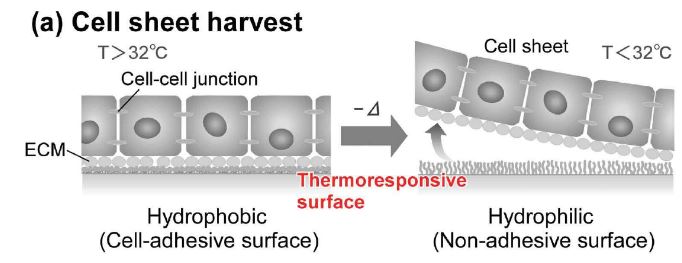 Fabrication of cell monolayer through a thermoresponsive (N -isopro-pylacrylamide – IPAAm) surface that becomes hydrophillic (non-adhesive) >32C. Tom’s idea is to place the thermoresponsive polymer on our membrane for co-culture to harvest a cell sheet while “reusing” the remaining one. This materials have been on my radar as well as the shape memory polymers. There is a research group at UTDallas that specializes in these materials, they have strong chemistry knowledge and capabilities as well as fabrication. I met with one of the professors who has been looking for a collaboration that enables him to study an biomedical application. Here are two related websites of their research: Dr. Voit (http://voitlab.com/) and Dr. Ware (https://warelab.co/people/)
Pei Yu Chiou, UC Berkeley (https://sites.google.com/site/uclaofsl/home)
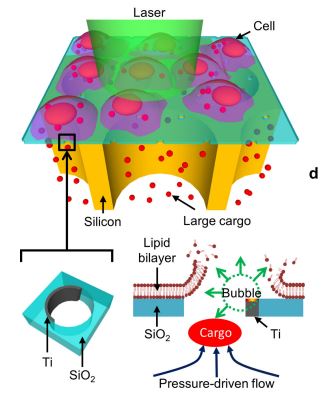
Photothermal nanoblade for large cargo delivery and biophotonics laser assisted surgery tool (BLAST).
Overall, the conference was a great way to remember some not-so-crazy ideas, identify some potential collaborators, and a good overview of other scientific areas that relate to our interests. Also…. sunshine.