
3D Printable Capture Device Design
A little while back I posted a design for a capture device that would (nominally) work for dialysis on real patients. Due to strict requirements to avoid clotting, the design included a lot of curves and nuanced structures that would be no problem for a lithographical or molding method, but which are a step too far for our current purposes. What we need presently is something that can be manufactured by 3D printing and that can be used to show device functionality in benchtop experiments. With this in mind, I’ve produced a new design.
One of the reasons such complicated structures were required for my previous design was that it’s difficult to distribute high flow streams across a wide area over a short distance. The higher the inlet velocity relative to the length of the device, the more the fluid tends to flow in a narrow jet from inlet to outlet. To alleviate this problem, I scaled this design down one-hundred fold using a non-dimensionalization of Fick’s 2nd Law. The end result of this scaling is that the inlet flow rate is reduced 100 times (from 1 L/min to 10 mL/min) while the blood channel height is increased 100 times (from 50um to 5mm.) Of course, you don’t get something for nothing; this scaling means that the dialyzer is now equipped only to dialyze a 1/100 scale model of a human, whereas the previous design worked at full scale. I haven’t done the math yet, but there’s a good chance this is in the ball park for treating a rat. Keep in mind that any other scaling factor would also be fine — I just picked this one for now because it’s an easy number.

In addition to the 2D simulation, I ran a simple 3D simulation with the proper channel heights. The flow spreads out pretty nicely in this simulation as well:
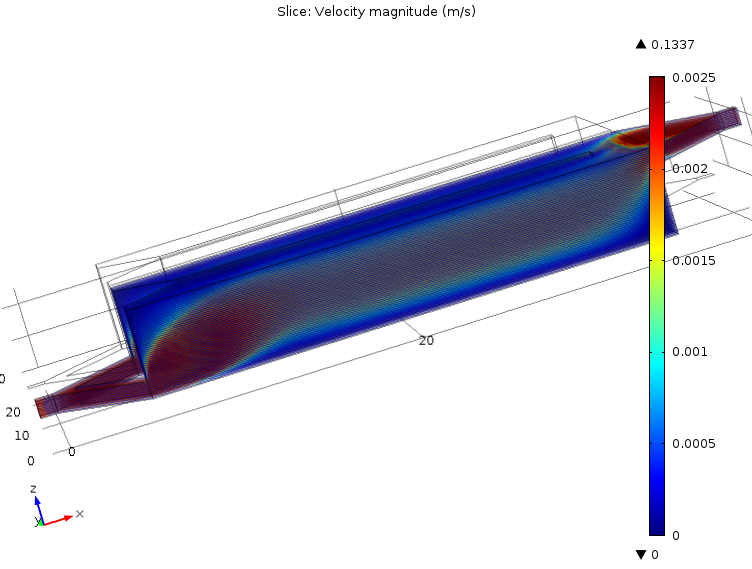
The main issue with this design is that blood will definitely clot in it, as the flow is far too slow to prevent clotting. This means that this design is only acceptable for benchtop experiments, dialyzing a beaker of toxins dissolved in buffer — NOT for an animal study. However, it should meet out current requirements.
Josh has converted this design into a model for 3D printing, so we’ll see soon enough if it works as intended! (This picture is from him.)

NOTE: Apologies for the formatting on this post. I seem to be unable to add blank lines for some reason.