
Surface Modification for Hemodialysis
We are continuing to work with the Shestopalov lab on surface modifiation of hemodialysis filters to prevent adhesion and activation.
Jim recently presented our status and strategy (PDF) to the Technical Development Fund and was awarded the balance of the award, so we may continue our work.
 Our goal is to develop hybrid hemodialysis devices to enable both nocturnal blood clearance and diurnal clearance augmentation. Quotidian ambulatory clearance will be enabled by large active area nanoporous nitride (NPN) from lift-off processing under development.
Requirements for Functionalization to prevent protein binding on SiN:
1. The length of the system <10 nm to avoid pore clogging
2. Stable attachment to silicon nitride, stability on curved interfaces, self-assembled phases that limit water diffusion to SiN vs non-hydrolytic covalent attachment
3. Amenable to vapor based deposition to enable scalable manufacturing on porous materials
Traditional Silane Functionalization:
- Unstable in water
- Pores create defects that will accelerate hydrolysis
- Solution-based reactions compromise surface coverage and mechanical stability
Strategy:
- Vapor-based carbenylation with diazirines is novel
- Vapor-based method will permeate porous materials and is scalable
- Potentially useful to modify any surface that has Si-H or C-H3
- Stable in aqueous environments and curved surfaces
Results:
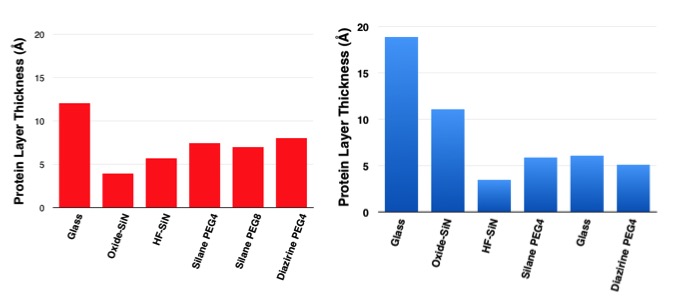
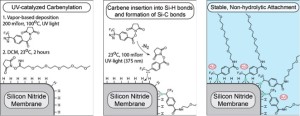 Carbenylation results are similar to results with standard silane-based reaction with additional benefits of stability and vapor-based deposition. The thicknesses of the molecular coatings are below 1 nm.
- The thicknesses of the non-specifically adsorbed protein layers are below 1 nm. No pore clogging is observed after the functionalization or adsorption experiments
- We suspect Fl-molecules left from HF pre-treatment are reducing surface density of PEG molecules


Functionalization Plans:
- Use BOE etch to increase the density of the PEG molecules in the carbenylation approach
- Explore carbonization technology developed by McGrath and Fauchet to create stable sublayer for the carbenylation and PEG attachment
Update by Jim: This is the document Alex used to begin the collaboration. It shows candidate molecules for non-fouling surfaces on both silicon and nitride.