
Thermodynamic Efficiency of EO with pnc-Si
EO permeability: We often refer to the ‘efficiency’ of EO with pnc-Si as being very high, but this may not be the case. What is actually high, as in the case of the other modes of transport, is the ‘permeability’ in EO. Dimensionally, the quantity we’ve referred to (in various places) as the ‘efficiency, the ‘normalized flow rate,’ the ‘flow rate,’ or the ‘intrinsic performance,’ is actually the flow rate per unit area divided by the transmembrane voltage. Just as with diffusive or convective permeability, this quantity is a flux normalized by the magnitude of the ‘driving force’ (voltage instead of concentration or pressure gradient) and it is at least two orders higher than all other materials we can find or test ourselves. While this permeability is relevant to our claim of high flow rates at low voltages, it is not technically an efficiency and it does not really describe the performance limits of pnc-Si. To calculate a real thermodynamic efficiency, we need to think in terms of the mechanical work done by our EO pump and compare this to the electrical power used to operate the pump.
About pressures: All EO experiments we have done so far have been at very low pressures. In other words the membranes have performed very little work. In the experiments for the submitted PNAS manuscript, wells on either side of the membrane were open to atmosphere and kept at an even height so that very little back pressure built up as the membrane pumped. In the experiments with the Borkholder group both tubes were open to atmosphere and the membrane simply needed to overcome the resistance of flow through the capillaries. We can estimate the magnitude of pressure needed to drive this flow with the Hagen-Poiseuille equation:
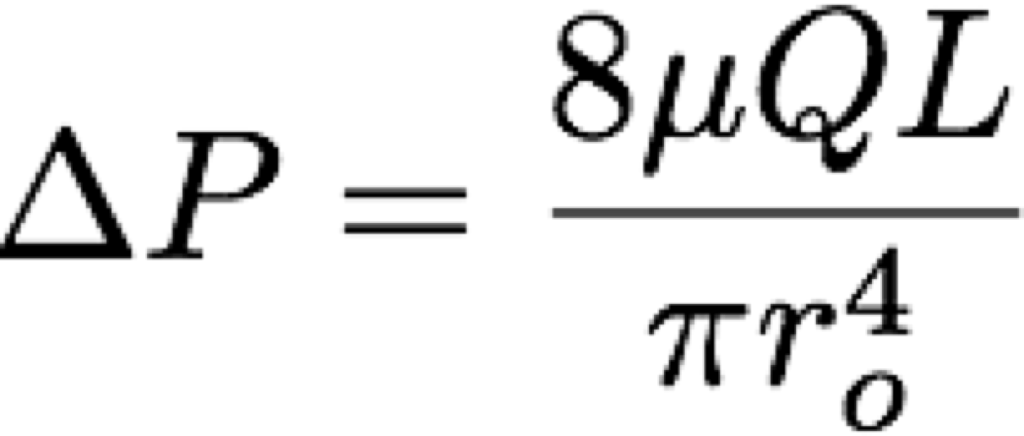
We estimate the length of water in the capillary L at 180 mm, while the flow rate was 1 ul/min and the radius of the capillary was 250 microns. The pressure drop is therefore a pathetic 1.96 Pa or 0.0003 PSI. Thus our EO pumps are not really working very hard. Even though the flow rates are just about right for microfludics (1-10 ul/min) and the applied voltages are low (1-10 V), what will happen when we shrink the channel dimensions or create closed systems? In these cases the pressures might get very high. Are the high voltages that others use for EO really because their pumps are inefficient, or because the resistances they are overcoming are huge?
Efficiency: Now that we know the pressure in the recent experiments, we can calculate the rate of mechanical work done and compare it to the electrical power input to calculate a true thermodynamic efficiency:

Note that the numerator is the rate of mechanical work while the denominator is the electrical power.
Chen and Santiago calculate the thermodynamic efficiency for a series of solutions with different salt concentrations:
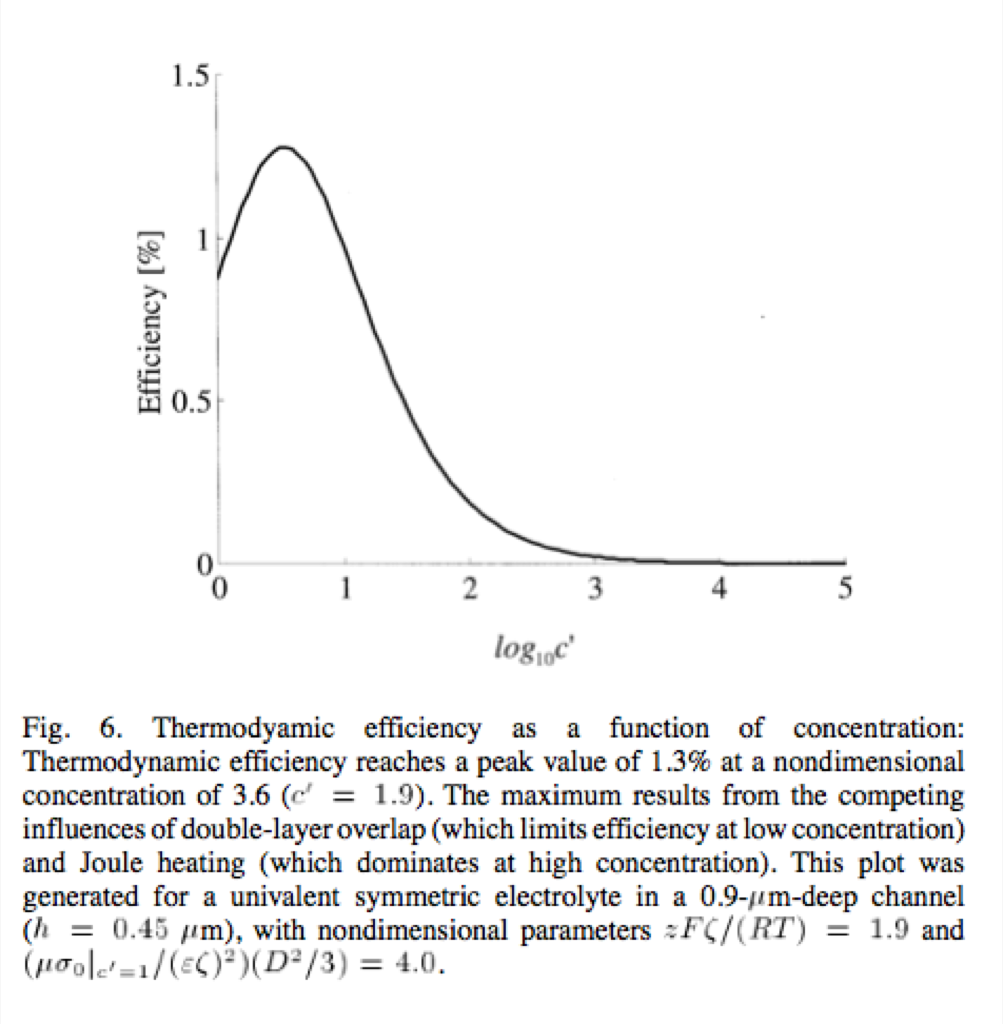
This figure shows that their planar micropump can theoretically reach a peak efficiency of 1.3%. Experimental measurements found a thermodynamic efficiency of 0.81% (Journal of Microelectromechanical Systems 2002 Chen).
Thermodynamic efficiencies were determined for the operating characteristics of our run (P=2 Pa, Q=1 uL/min, V=2 V, A=.3e-3 mA, no 1/4 multiplier). This gives a thermodynamic efficiency of 5.7e-6% for applied voltage and 0.0011% for a 10 mV effective voltage.
A comparison to the thermodynamic efficiency from a single run is performed from the Chen paper using the following figure:

Using the 1 uL/min flow rate at 1 atm and 3 kV (no 1/4 multiplier), I calculate an efficiency of 0.008%, which is lower than the efficiency for the max flow rate and pressure at this voltage. This value is much closer to the efficiency we obtain for our device and indicates that the use of maximum quantities in our calculation will provide a higher efficiency.
Power: Electrical power is determined by the following relation:

Using the running characteristics of our low voltage EO pump (2 V, 0.3 mA), the power can be calculated as 0.6 mW.
Pressure Distribution: While the pressures are tiny it is nonetheless interesting to think about the pressure distribution in our recent microcapillary experiments. Note that both ends are open to atmosphere. Thus the membrane pump acts like a vacuum to pull on the upstream side and pump to push on the upstream side. We would expect it to deflect backward against the flow.
