
Protein through carbonized pnc-Si
In an attempt to address the Nano Letters reviewer’s comment (show molecular separation, not just Au), I ran a simple experiment where I tried to pass BSA, Cyt. C, IgG, and β-galactosidase through carbonized membranes in the pressure cell. We have to be careful in calling this a “separation” since the two different species were never mixed. Instead, we just want to demonstrate the relative passage of protein to solvent through a carbonized membrane. The hypothesis is that Cyt. C will have no problem passing through, while the BSA will be hindered, and the IgG and β-gal completely blocked.
I started with 200 uL (1x PBS & protein) of 1 mg/mL (for all proteins) on the retentate side. I wet the front side with 20uL of 1x PBS and then drew it off to wet the pores and initiate flow. I then pressurized the SepCon at 3 PSI until 50 – 100 uL of solution passed (took variable times from 30 min to 1 hr). I then measured the absorbance of the filtrate and extracted a concentration passed from the standard curve. I made sure to blank off all the wells in the Nano Quant with PBS and subtracted that from the measured signal. Here is the membrane I used (SC 618 carbonized at 700 C at 1 LPM acetylene for 5 min):

Here is the raw absorption data and standard curves:
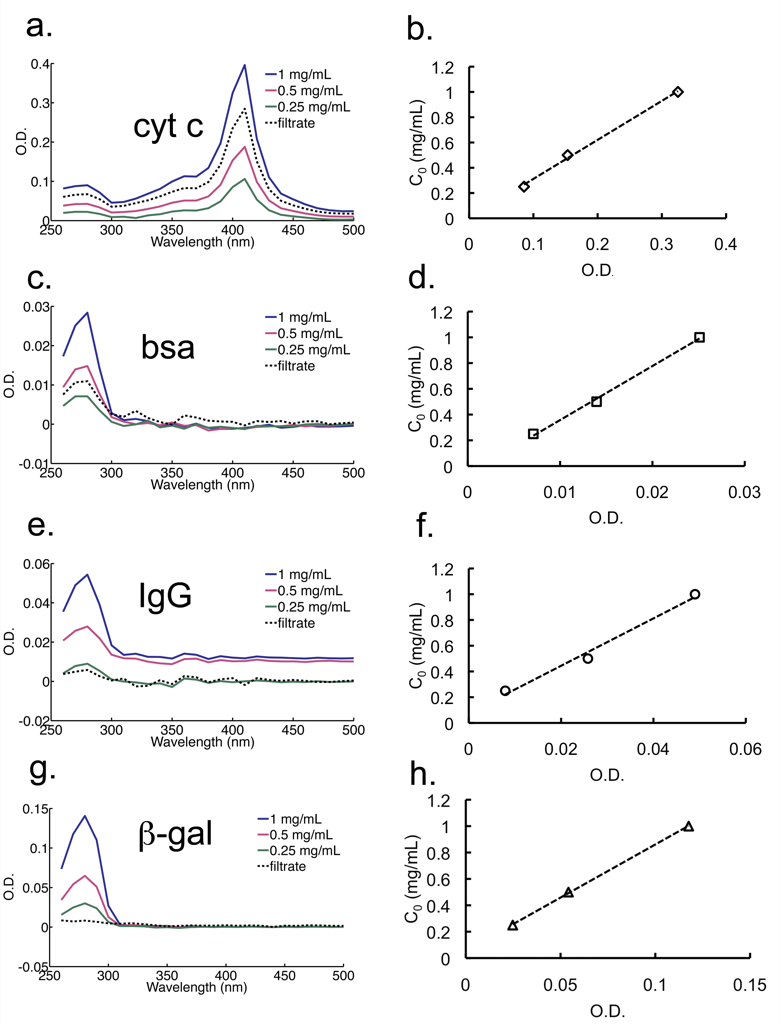
Here is a table showing the MW and DLS size data (taken from Jess’ diffusion paper) and the sieving coefficients
|
Protein |
MW | Diameter (nm) | Cfiltrate/C0 |
|
Cytochrome c |
13.4 kD | 4.24 ± 0.96 | 0.73 |
| Albumin | 67 kD | 11.08 ± 3.98 | 0.39 |
| IgG | 150 kD | – | 0.17 |
| β-galactosidase | 464 kD | 15.48 ± 4.78 |
0.11 |
The question now is what to include in the carbonization manuscript. My thought would be to include this table (without the IgG since we don’t have DLS data on it and the shape is funny which could lead to questions about transport). Like the Au presentation, I’ll leave off the pore histogram since we are going to address the issue of convective transport of molecules through pores in a later paper.
Pores need to be less than 20 nm to start blocking BSA. The one time that I got a BSA/cyt c separation was with a low porosity membrane (~1%) with pores around 10 nm.
Try BetaGal (ask Jess) to see if we can get complete blockage.
Given the pore dimensions of this membrane, I wouldn’t expect much beta-gal to go through by diffusion, but seems that it’s more able to pass in the pressurized situation. It’s much larger than IgG molecular weight wise, but may be more compact. We can get DLS of IgG, although the shape does still raise some questions. Beta-gal is much more globular.