
How does the membrane affect the separation?
In the previous post it seems that the membrane pores do not significantly retard proteins and that the separation characteristics are due more to the slower diffusion coefficients of the proteins. However, in certain circumstances, the membrane may provide more of an effect. All of these experiments and simulations took place in a relatively large volume (20ul top, 20ul bottom) and over a long time. The membrane may contribute more to the separation in small volumes and at short times. Additionally, changing the pore characteristics of the membrane will have an effect as well.
This is just the documentation of my first attempt to look at some of these variables via simulation. I created a low volume chamber (3ul top, 3ul bottom) and ran simulations for shorter time steps. I then took the ratio of filtrate to retentate ratios of these simulations and compared them to simulations without membranes in order to find an effective diffusion coefficient which could be used to describe the rate of diffusion for the entire system. To obtain the effective diffusion coefficients, linear interpolations were used from figures similar to the following:
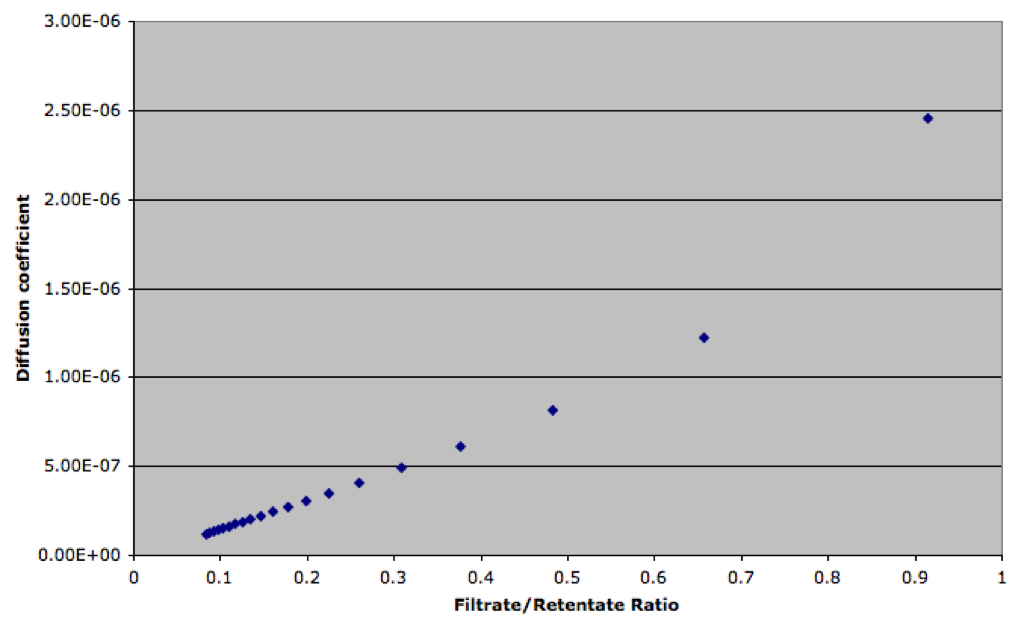
This may create a bit of error, but the next step is to increase the points within the curve to get a better interpolation (see making things faster section). I’ve tried fitting these curves, but high order polynomial curves do not always work well as the curve approaches an asymptote.
In the following figure I compare the effective diffusion coefficients for the different simulations:
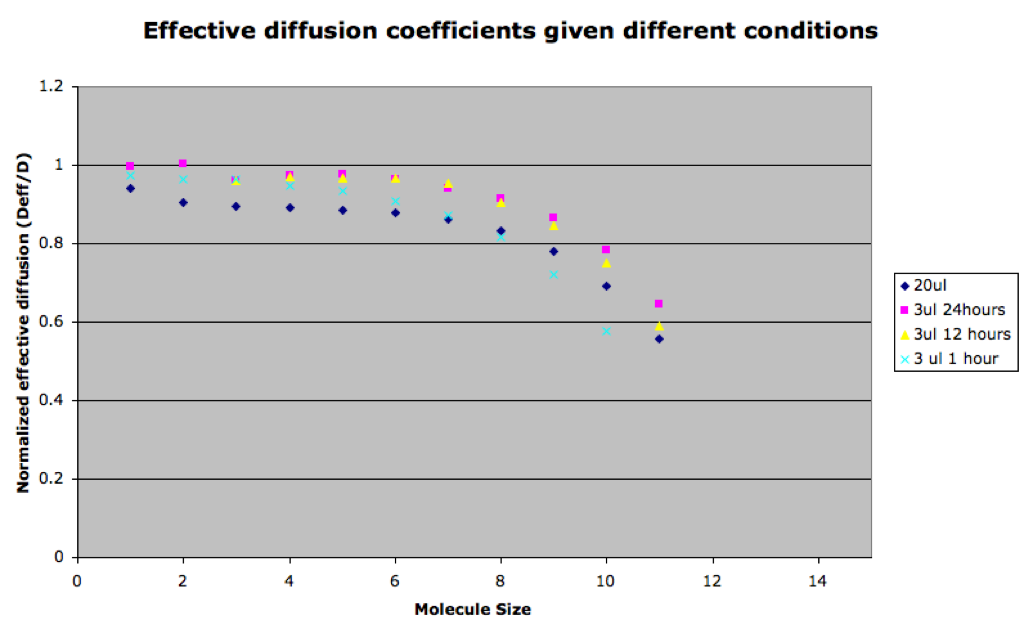
In this preliminary figure, I show that the effective diffusion coefficient is similar to the free diffusion coefficient for small sized molecules, but drops as the molecules get larger. The cutoff for this membrane is around 15nm and one would expect the effective diffusion coefficient to be zero there (remainder of curves pending as I work on the interpolation). There’s a little bit of a spread in these curves and it is difficult to say if this is from errors in the simulation geometry or actual due to an effect like the difference between renkin and capture (adsorber, Amemiya, still looking for a good term for this) permeabilities However, it does appear that the lowest volume, shortest time curve has the most influence from the membrane, or the sharpest drop in effective diffusion.
Making things faster:
I have been spending some time figuring out how to do large batches of simulations. It turns out that COMSOL can be run by MATLAB. To do so, comsol geometries can be meshed using the COMSOL gui and saved as an m-file. MATLAB can then be synched to COMSOL and the m-file can be run in the MATLAB command window. The m-file can be altered so that it contains for loops which enable the changing of variables and saving of outputs in the MATLAB environment. This should enable me to set up many simulations at once and allow them to run and process more quickly.
Are these 1-D or 3-D simulations? If they are 3-D, how is the volume distributed on both sides of the membrane? It seems like stepping back to a 1-D model with different fluid thicknesses on each side would be the best approach for the issues discussed above, right? I’m worried that the lateral geometry issues with the 3-D model will create effects that non-intuitive and will mask our fundamental understanding.
Also, is this an ideal membrane with 15nm pores with X porosity, or is some pore size distribution used?
This is a 3-D solution with the same volume on each side (although the top side has a slightly different geometry due to the silicon slits). Also a pore distribution was used to create these simulations. All of this work is done with the membrane used in the experimental separations.