
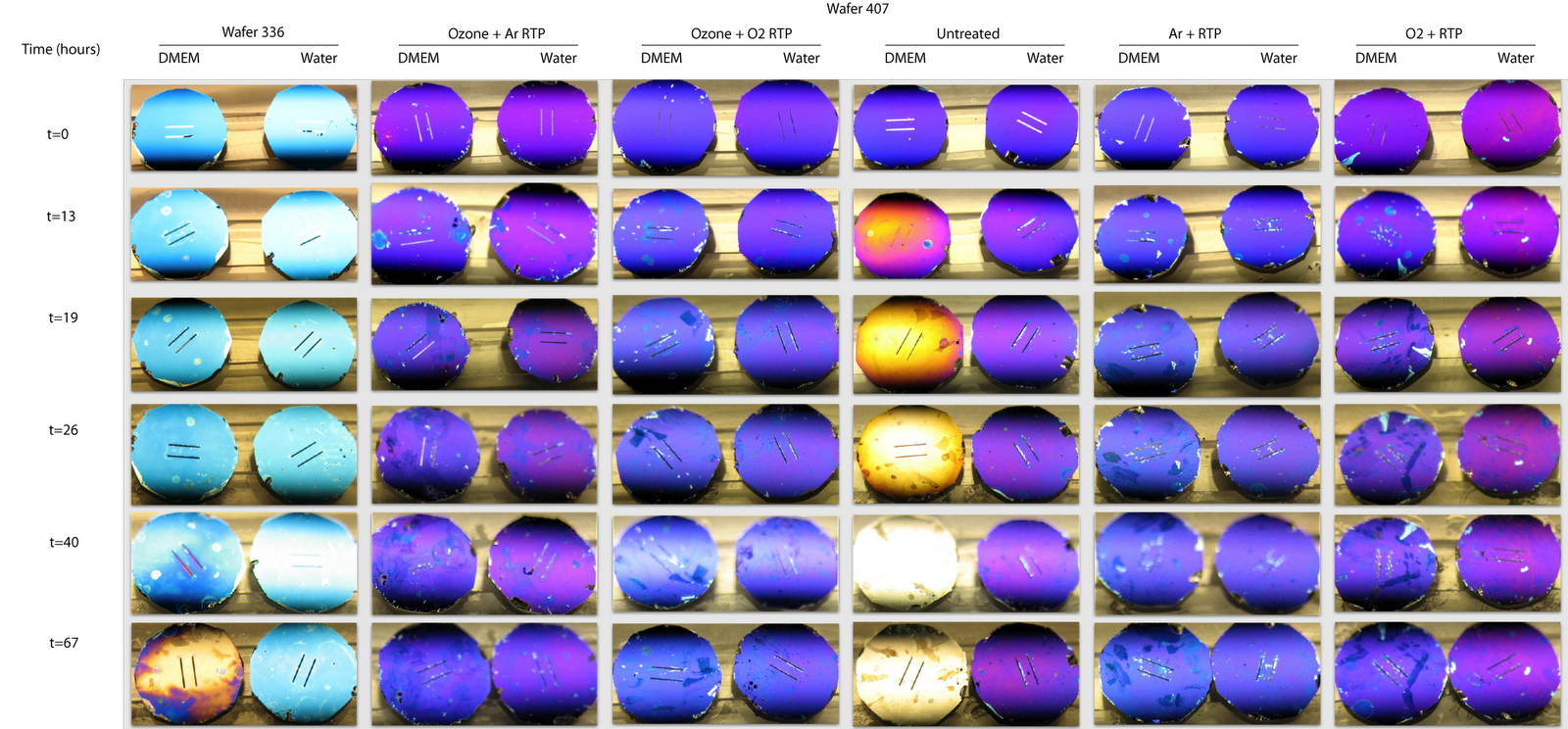
RTP treatment helps!
Summary: I have some ok images (20x) of cells growing on MgF2. My controls still look poor. Something about the stain is causing the TCP + NPN controls to detach ahead of the MgF2 material, even if they aren’t fully dead yet. I used acetone fixation, which worked well for the materials on the nanomembrane, but…
A group published a paper in Lab on a Chip (2012) using track-etched membranes for electro-osmosis. There are a lot of eerily familiar terms and concepts in the paper. The title even sounds familiar: Low-voltage electroosmotic pumps fabricated from track-etched polymer membranes They created a device with metal mesh electrodes on the opposite sides of…
Kevin was kind enough to share his presentation with us from his visit this July: Here is the link on Owncloud: http://drive.bbe.23a.myftpupload.com/public.php?service=files&t=c3eceae62439a478b4d1b676924e45ee
I got some wafers from Chris last week(?) that had undergone different Megasonics cleaning treatments by the manufacturer. We’re trying to figure out if these treatments are actually cleaning the wafers. I’ve been having trouble getting the AFM to stay in the “right” mode for imaging with these wafers. However, I have gotten some images….
This is a quick post on comparing the contact angle after ALD on pnc-Si with aluminum oxide vs the untreated material (+/- ozone). The hypothesis is that the angle should drop since Al2O3 is hygroscopic. The angles are 85°, 45°, 61°, and 50° for the untreated, ozone, Al2O3, and Al2O3 and ozone case, respectively. These…
Paper can be found here I am working on developing an analytical model to understand how to accurately post-process the resistance values I obtain from my TEER measurements. This paper addresses a similar issue and comes up with a correction factor to match the TEER values obtained in a microsystem with the ones obtained from a…
Terrific looking study. Now we just need a little help interpreting … what could Ar/RTP without UV/ozone have done to change things?
Jim,
Even without UV/ozone treatment before RTP, there is an initial native oxide on silicon. RTP is basically annealing. RTP is normally used to either diffuse dopants, cure lattice distortion or site dislocation due to implantation, and densify the oxide layer. Here denser oxide should play the role improving chemical stability.
The thing I am not 100% sure is, since native oxide is about 1-2nm thick, is that already enough for isolation?
Anyway, something about UV/ozone…
when I set up the UV/ozone, I thought it was only used to do the contamination cleaning… actually I don’t think incubate silicon in ozone chamber can result in a thick oxide layer.
Some of the membranes break over time even though the color is holding steady. I assume that to take these pictures you need to remove the membranes from the liquid and partial drying might be causing this?
Also some membrane were broken from the start. We should discuss (or test) the ability of the membranes to hold up to these treatments.
It seems clear that the RTP treatment is helping with bio-stability of the membranes, so we should now start looking into weather we are creating any other problems with flow and/or strength.
The whole reason for trying the RTP treatment was to see weather we can further stabilize the surface oxide and/or grain boundaries. We apparently are, and it’s curious that everything that was tried with the RTP worked over this experimental duration. Are these studies ongoing? What is our target stability – say 1 week?
In these experiments I’m not too concerned about the membranes breaking after drying. If they were broken before drying, I would be slightly more concerned. This is really problematic material anyway, so we cannot draw any real conclusions about the material strength.
Update after one week duration: We were wondering why should Ar RTP help! Here’s something that’s showing up.. The Ar RTP samples started discoloring in a week’s time, whereas the O2 RTP treated samples still remain intact in DMEM. Thus, RTP is helping for sure but O2 RTP is better than Ar RTP.