
1085 MgF2 TEM Stereography Reconstruction
I’ve received some of the very first MgF2 material that I produced way back when and shipped off to Nottingham. These chips were produced from NPN wafer 1085 (5-slots). There are a few membranes still remaining, but mostly the chips are in tatters.


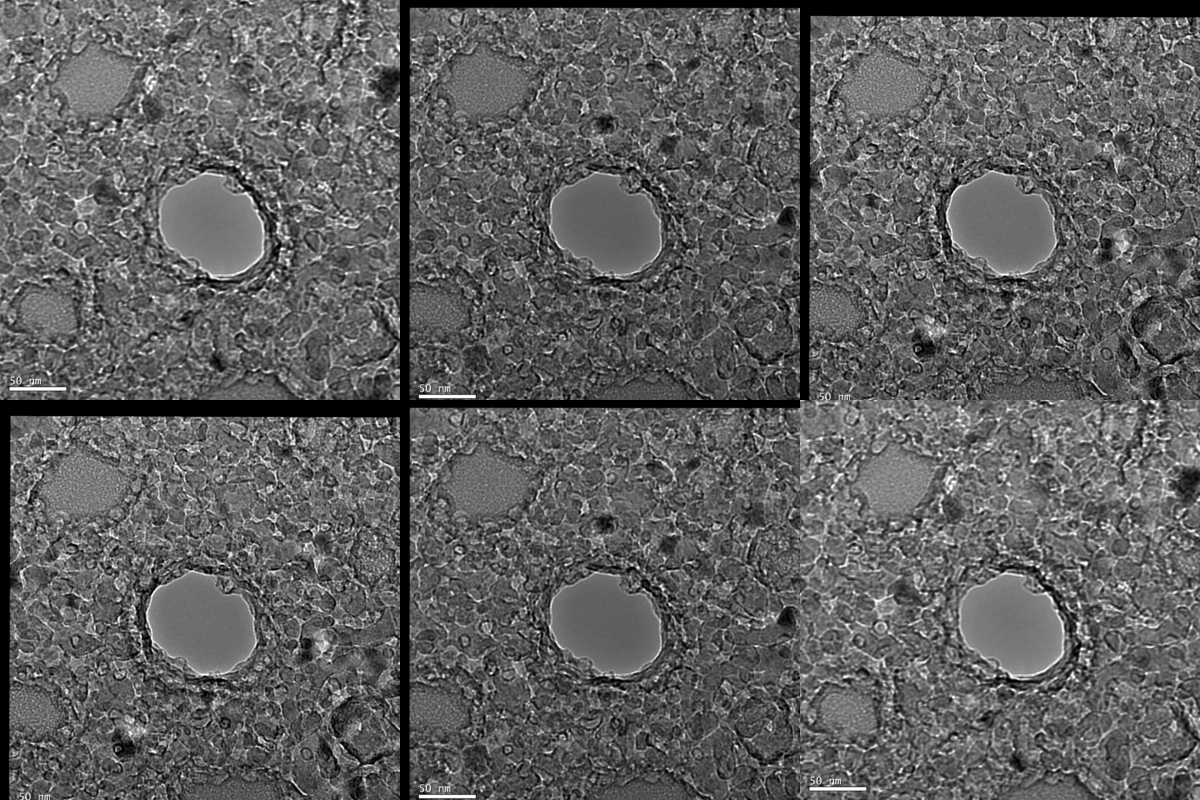
Tomogram Reconstruction
- Weighted Back Projection (quick and dirty)
- We can tolerate the noisiness at this point.
- TomoJ
- 200 pixels thick
Observations
- The angle of the volcanoes are shallow from entrance to exit.
- I believe this would help the gold infiltrate the nanovolcano and ultimately constrict in a small pore. A shallower angle of incidence means that it is easier for the gold to sputter on to the surface evenly.
- The internal structure of the nanovolcano is rough, but not as rough as some of the stuff I have made recently
- Compare with NPN, which is much smoother
- Severely reduced porosity
- Not sure how this impacts SERS functionality
- May have been scumming from sitting in a gel box for 3 years, not a native structure
- Volcanoes aren’t particularly tall
Segmentation
- I used SEG3D2 to perform segmentations instead of FreeD
- Filters
- Gaussian Blur (rad = 4 pixels)
- Crop (to features of interest)
- Mean (rad = 4 pixels)
- Masks
- OTSU Threshold (Logarithmic, 4 thresholds)
- I selected 2 thresholds that highlighted structures
- Combined OTSU thresholds with OR into one mask
- Smooth Dilate (8) Erode (6)
- OTSU Threshold (Logarithmic, 4 thresholds)
- These steps are all justifiable to identify structures in the tomogram stack. I didn’t touch the masks by hand, but cleaning up the masks, will make nicer prints and segmentations in the future.
- Filters


Next steps: Quantification of physical properties
Having generated some tomograms in the past months, I should be able to parameterize these structures. Remember, we are using the MgF2 as an analogue for the SERS active Au. Central to this assumption is that physical properties of the MgF2 are eventually imitated by the Au layer that is deposited on top.
- Surface Roughness ~= Material
- Is MgF2 special? Evidence exists that NPN doesn’t have as nice SERS properties when coated with Au, but could we make it rougher with a different material/etching process?
- Conicity
- Modeled as fitting to some hyperbolas, with some degree of fit.
- Pinched ovals versus circles, which is better?
- Pore Size
- SERS properties should increase exponentially the closer the gold gets to itself. Yet 1085 has larger pores than the 1147 material.
- How does this relate to the conicity?
- How does the gold infiltrate these structures? I suspect a shallower cone allows the gold to get closer together.
- SERS properties should increase exponentially the closer the gold gets to itself. Yet 1085 has larger pores than the 1147 material.