
Asymmetrical Oxide Experiment
Based on previous data, we have seen a reduction in pore size and porosity when we increase the oxide thickness. For this experiment, we compare asymmetrical oxide thicknesses with symmetrical oxide thicknesses to observe which layer has the dominate effect on pore size and porosity. Wafer 718 is a 40/15/40, 719 is a 20/15/20 and 720 is a 40/15/20. All wafers are deposited with a 5W Si bias and share the same anneal conditions (1000C at 100C/s).
Wafer 718 : Porosity – 6.2% Average Pore Size – 12.3%
Wafer 719 : Porosity – 12% Average Pore Size – 17.1%
Wafer 720 : Porosity – 13% Average Pore Size – 19.8%
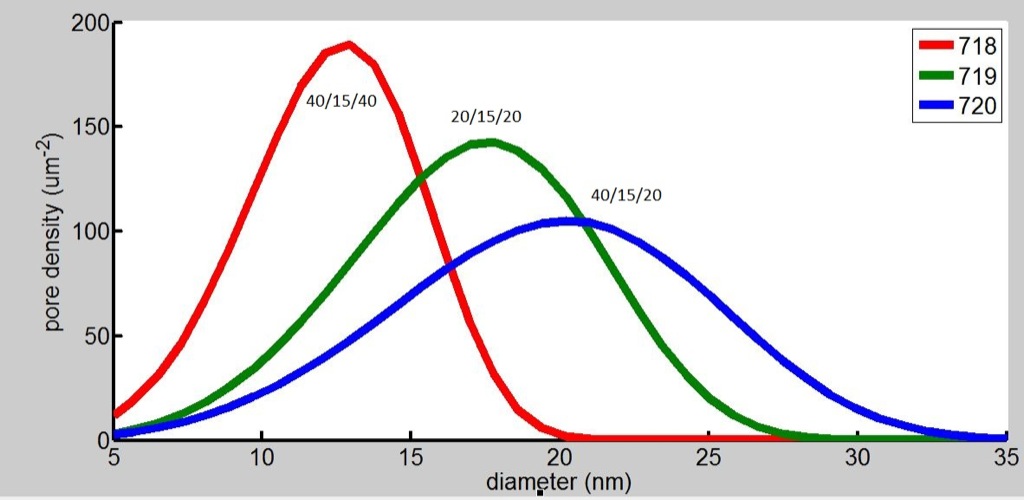
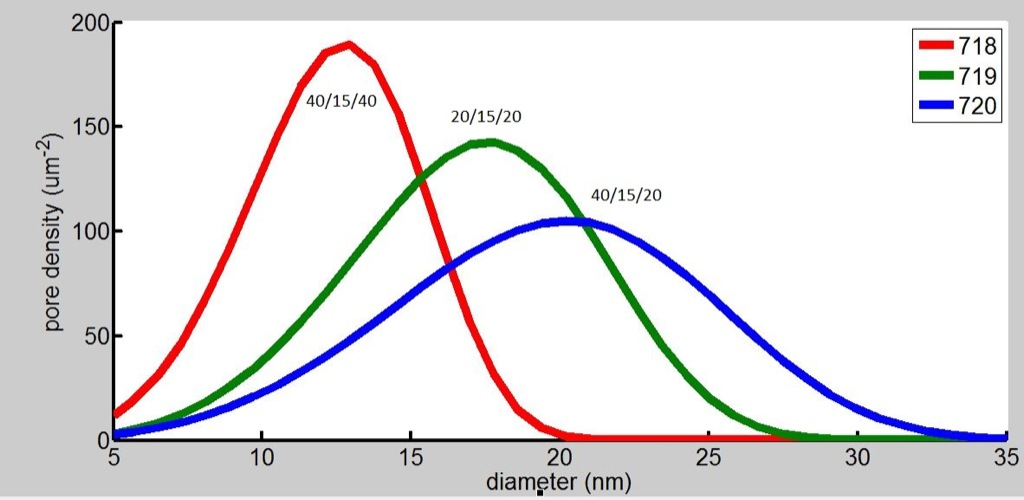
From the data, our controls agree with previous data where the thicker oxide (718) has significantly lower pore size and porosity than the thinner oxide (719). The asymmetrical oxide showed very similar conditions to the thinner oxide. These results show that the top oxide is a significant factor in control pore size and porosity at least for the 20 nm to 40 nm range. We did see some anomaly in this experiment because these film conditions should have yielded bigger pores for the 20/15/20 5W film conditions at these anneal conditions.
With this new understanding of pore size and porosity control, I think we have a lot more flexibility on picking more optimal film conditions.
very interesting- this really suggests we should do a series with increasingly thinner top oxide layers- eventually going to the agglomeration regime Joe has seen. Can we do this quickly, with say 20, 15, 10, and 5 nm oxide?
could you also email me the figure as I am having a hard time trying to import it. Thanks,
P. Fauchet
Sure, I also updated the post so the figure can be loaded as bigger image. I haven’t posted in so long on the blog I forgot how to get the images set right.
Charles
I am puzzled as to why 719 falls between the two other samples – or perhaps why 720 shows a higher porosity and average pore size than the 2 others. If one goal is to make high porosity samples that have very small pores, your results suggest that we should increase the thickness of both oxide layers- can someone try this?
I’m not sure why 720 shows a higher porosity and average pore size. I suspect that the thicker bottom oxide might promote pore size and porosity.
Increasing both top and bottom oxide has usually shown a decrease in pore size and porosity.