
Ordered carbon growth on aluminum oxide coated pnc-Si
Today while I was imaging a Al2O3 coated pnc-Si membrane on the high-res TEM, I noticed something curious as I placed the beam on a single pore for a few minutes. I was initially interested in the structure of the aluminum oxide coating, but found that something started to deposit on the pore walls as I was imaging. We oftentimes see carbon deposits form on samples, but this time the carbon was ordered.
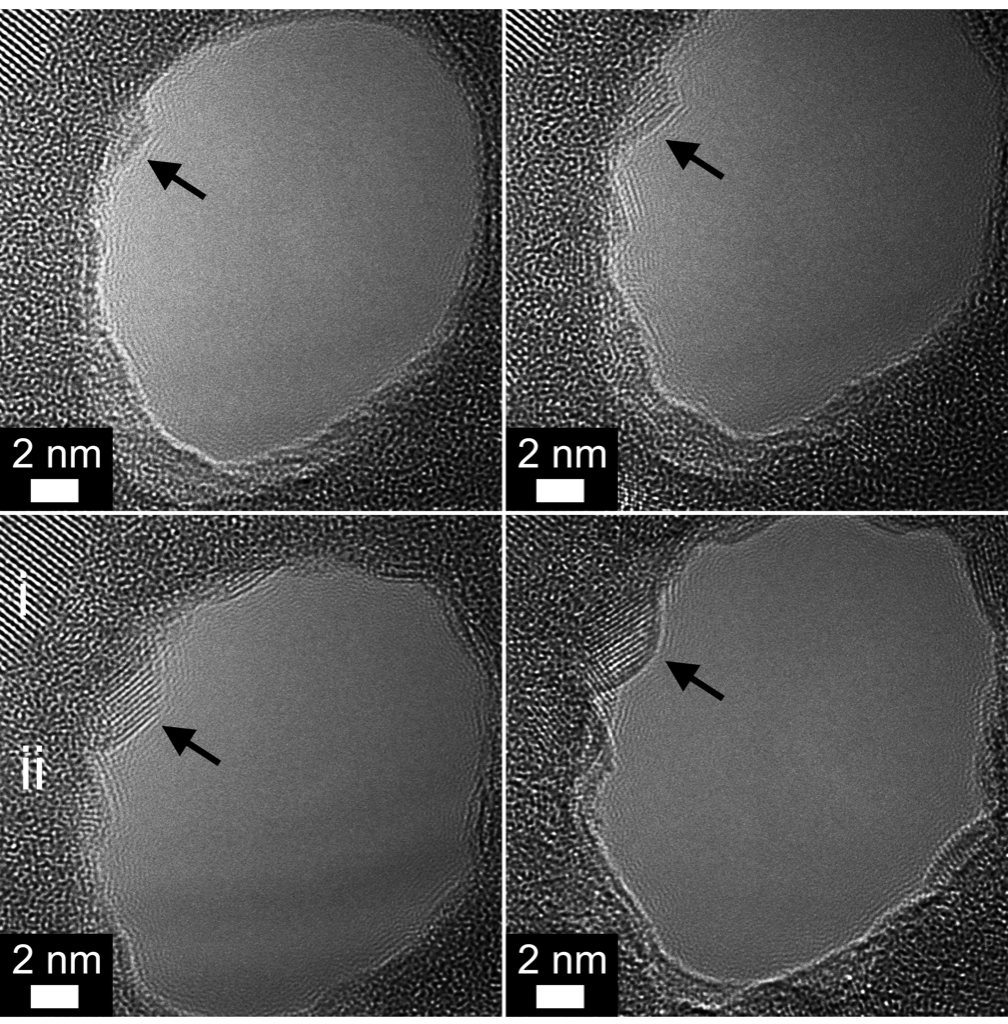
The image above shows a series of images taken a few minutes apart (clockwise starting at top left). The area where the arrow is pointing to shows ordered growth of carbon on the aluminum oxide coating. The (i) and (ii) mark a Si nanocrystal and Al2O3 ring, respectively. The spacing between the ordered atoms is 1.8 A in the images above. The carbon-carbon bond (between atoms, not layers) in graphene is 1.4 A. The spacing between ordered atoms in carbonized pnc-Si is 3.6 A, which is consistent with the distance between sheets of graphene.
This made me wonder what would happen if I carbonized an Al2O3coated pnc-Si membrane. The idea was motivated by the fact that people have reported the use of alumina membranes as a template for growing carbon nanotubes, which then showed to have enhanced water transport properties.
I took a pnc-Si membrane with a 2.5 nm alumina coating and carbonized it at 750C for 5 minutes with 1 LPM of acetylene. This was the recipe that I used on bare pnc-Si to get a 8 nm reduction in pore diameter (4 nm carbon coating along the walls).
I was surprised to find that all the pores were filled after 5 minutes of treatment!

You’ll notice in the micrograph above that the ordering starts immediately at the alumina/carbon interface. This indicates that the carbon “likes” to grow on Al2O3more than Si. When carbonizing on a bare Si surface,the first layers of carbon that are deposited grow at a slower rate because of the carbon to silicon lattice mismatch (?). If you recall, we only observe ordering of carbon in bare pnc-Si after an initial “amorphous carbon” region was developed. In this case, only after a few layers does carbon growth start to proceed at its “natural” rate. Since carbon is better matched to alumina, the alumina acts as an “adhesion” layer for the carbon film.
I tried to carbonize a membrane again, this time reducing the soak time from 5 minute to 1 minute. I was able to find a few open pores, but the electron beam quickly closed the pores off as soon as I started to image.

Update:
I reduced the flow rate (from 1 lpm to 0.5 lpm) and temperature (from 750C to 700C) of carbonization and was able to coat a pnc-Si membrane with alumina with ~2 nm of carbon. I also cleaned the TEM stage in an oxygen plasma to reduce the carbon deposition that was occurring during imaging.
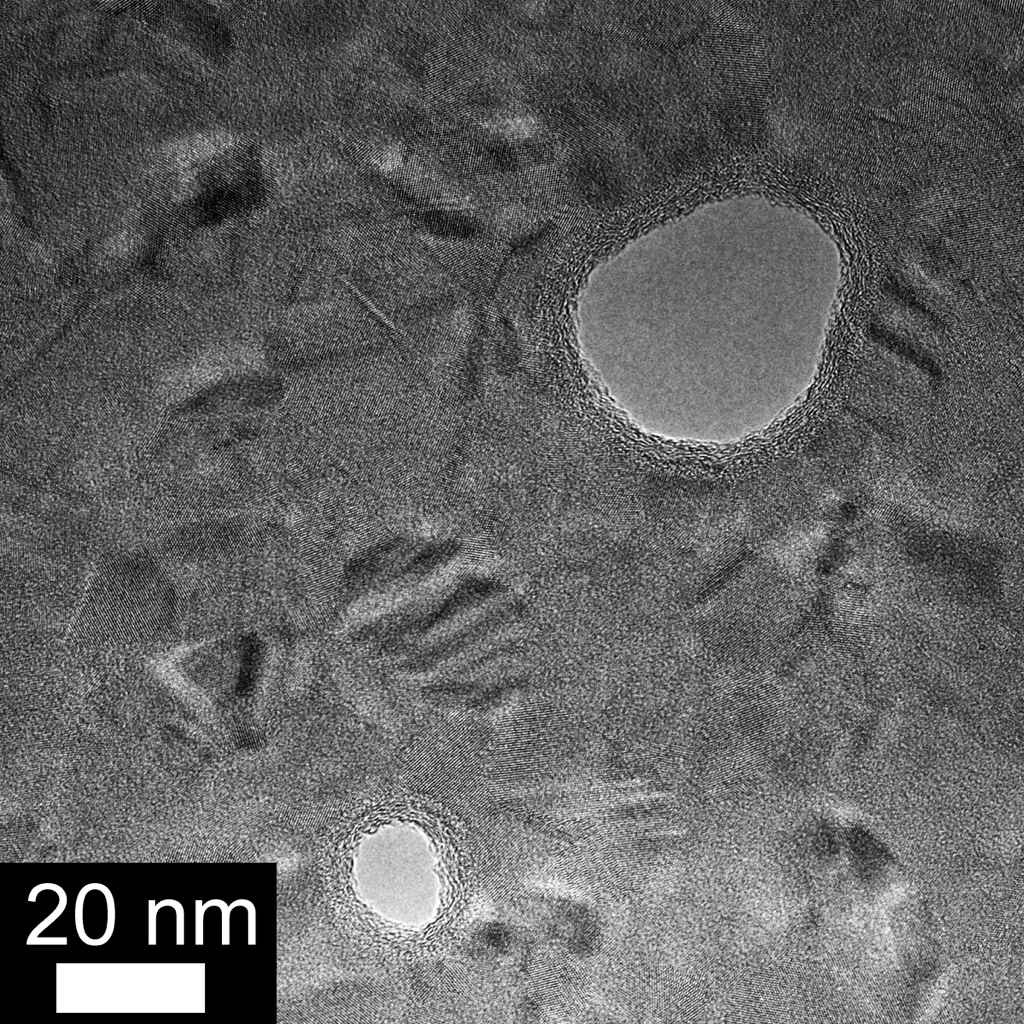
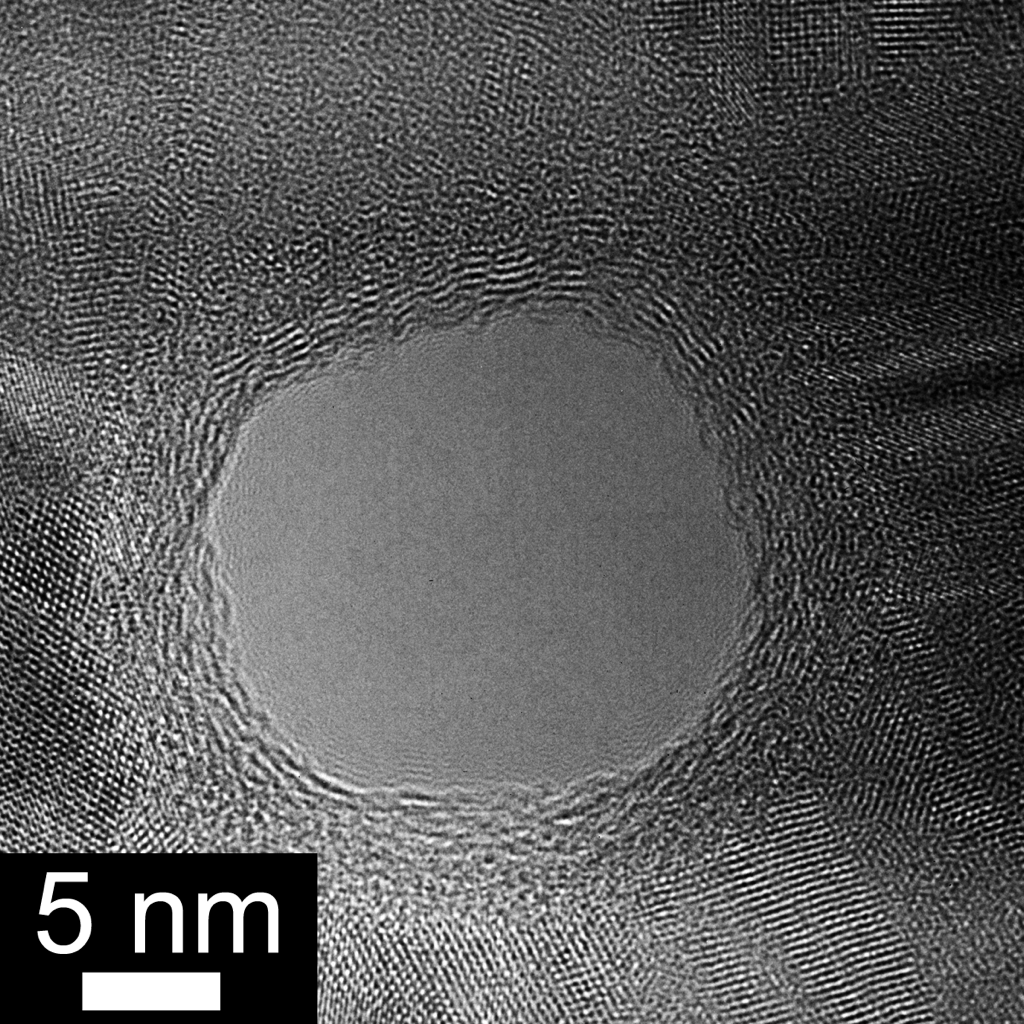
To me, it seems that there is more ordering when carbonization follows an aluminum oxide deposition.
This is really really cool on a number of levels and is a great basis for a follow-up paper to the one in Nano Letters. Combining the ALD with this quasi-CVD graphene growth is very interesting and I’d like to see a side-by-side comparison to growth on the bare membranes. The longer seeding time on the bare membranes would seem to imply a resistance to growth that seems to be overcome when the graphene growth mode takes over.
I don’t think this is really a lattice matching issue, since graphene is strictly a 2-D lattice – it basically “floats” on the underlying material with some van der Waals adhesion. The leading materials for graphene growth are Cu and Ni, so if we could figure out how to line our pores with either of these, it would be quite telling. The Korean group that recently demonstrated growth of 1m^2 graphene films for display applications used Cu (Nature Nanotechnology). This affinity for metals could be why Al2O3 is favored over SiO2.
IT would be great if we could find an application for this. Maybe gas separations using the gap between the layers in the filled pores? You maybe have to damage the top and bottom surfaces, though, to expose the gaps between the layers…