
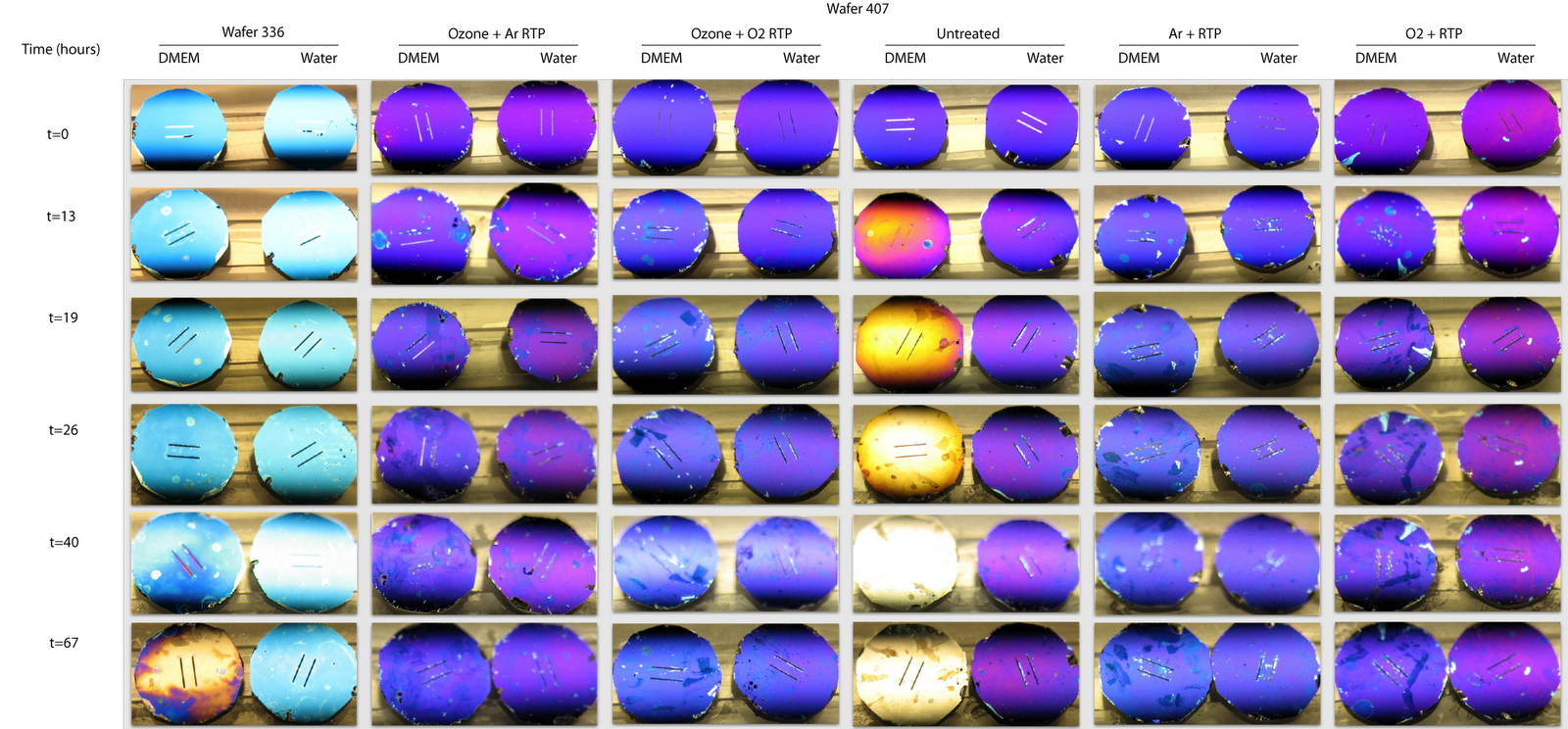
RTP treatment helps!
This is my first attempt to grow astrocytes (NG108-15 cell line) on PET and pnc-Si transwells. These are passage 8, seeded at 50000 cells/cm2 and grown for 7 days. Of the 8 pnc-Si transwells (RTP’ed SC104) I made, all but one survived this 7-day cell culture experiment. These cells were plated on the bottom on…
Tweaking simulation was not bringing it any closer to the experimental shown in the last post. This led me to try the experimental once more. I set up the same system and used 1:2 dilution of the standard protein mixture. I then homogenized the retentate and filtrate and ran 10 ul of each on a…
From Jess’ manuscript … From Wikipedia … From Tom’s ACS nano paper … The Dagan equation (2) for flow through short pores used to predict flow through pnc-Si is given by: where r is the average pore radius, DP is the pressure drop across the membrane, l is the membrane thickness and m is the…
Continuing my work from last week, Tucker used the same tenting (NPN, vapor transfer) and incubation procedure (20 nm and 60 nm Au particles) on an oxide substrate with posts (200 nm high). The substrate was dessicated in the 70C oven overnight. No additional platinum or gold coatings were made. The sample was tilted slightly…
Yesterday I used the Melvern to determine particle size and zeta-potential for BSA in DI-water. For the particle sizing I used a concentration of 2mg/mL but I had to increase the concentration to 10mg/mL in order to get an accurate zeta-potential measurment. As shown above the size measurements provided an average diameter of approximately 5.6nm….
Hello everyone, Aslan and I attended talks regarding EVs enrichment which can be divided into two broad categories depending on their ability to recover and reuse the EVS or not. There is a recent review called “New technologies for analysis of extracellular vesicles” published this year on Chemical Reviews. Their breakdown of the different methods…
Terrific looking study. Now we just need a little help interpreting … what could Ar/RTP without UV/ozone have done to change things?
Jim,
Even without UV/ozone treatment before RTP, there is an initial native oxide on silicon. RTP is basically annealing. RTP is normally used to either diffuse dopants, cure lattice distortion or site dislocation due to implantation, and densify the oxide layer. Here denser oxide should play the role improving chemical stability.
The thing I am not 100% sure is, since native oxide is about 1-2nm thick, is that already enough for isolation?
Anyway, something about UV/ozone…
when I set up the UV/ozone, I thought it was only used to do the contamination cleaning… actually I don’t think incubate silicon in ozone chamber can result in a thick oxide layer.
Some of the membranes break over time even though the color is holding steady. I assume that to take these pictures you need to remove the membranes from the liquid and partial drying might be causing this?
Also some membrane were broken from the start. We should discuss (or test) the ability of the membranes to hold up to these treatments.
It seems clear that the RTP treatment is helping with bio-stability of the membranes, so we should now start looking into weather we are creating any other problems with flow and/or strength.
The whole reason for trying the RTP treatment was to see weather we can further stabilize the surface oxide and/or grain boundaries. We apparently are, and it’s curious that everything that was tried with the RTP worked over this experimental duration. Are these studies ongoing? What is our target stability – say 1 week?
In these experiments I’m not too concerned about the membranes breaking after drying. If they were broken before drying, I would be slightly more concerned. This is really problematic material anyway, so we cannot draw any real conclusions about the material strength.
Update after one week duration: We were wondering why should Ar RTP help! Here’s something that’s showing up.. The Ar RTP samples started discoloring in a week’s time, whereas the O2 RTP treated samples still remain intact in DMEM. Thus, RTP is helping for sure but O2 RTP is better than Ar RTP.