
(Very) small molecule diffusion through pnc-Si transwells
We have a high school student, Nikita, (from my Summer Nanotech class) who is volunteering in the lab. Jim and I have assigned him the project of exploring diffusion of very small molecules through porous and putatively nonporous membranes. Currently, we are focusing on hydrogen peroxide (H2O2 = 34Da) and detecting it with the Amplex Red fluorescence assay from Invitrogen.
We are using the transwells with round Sepcons, so these are pretty big volumes:
Apical side (donor) = 300μM H2O2, 200μL
Basolateral side (receiver) = DIH2O, 1000μL
In this 1st experiment, we made a stock of 300μM H2O2 from some old ~30% H2O2 in the fridge. I don’t know if I trust this stock solution of H2O2. We set up the experiment, let it run for 24 hours and then detected fluorescence (550nm/590nm) with the Amplex Red kit. This assay is a pain because the reagents are only stable for <1 day and each batch makes enough solution for 100 assays. For this run, we did about 70 tests.
Here’s the standard curve (average and standard deviation of triplicates) made with fresh H2O2 (from the assay kit). I set the gain to assign the max RFU to the highest standard concentration (20μM). It’s linear to high nM concentrations:

Here are filtrate H2O2 concentrations after 24 hours:
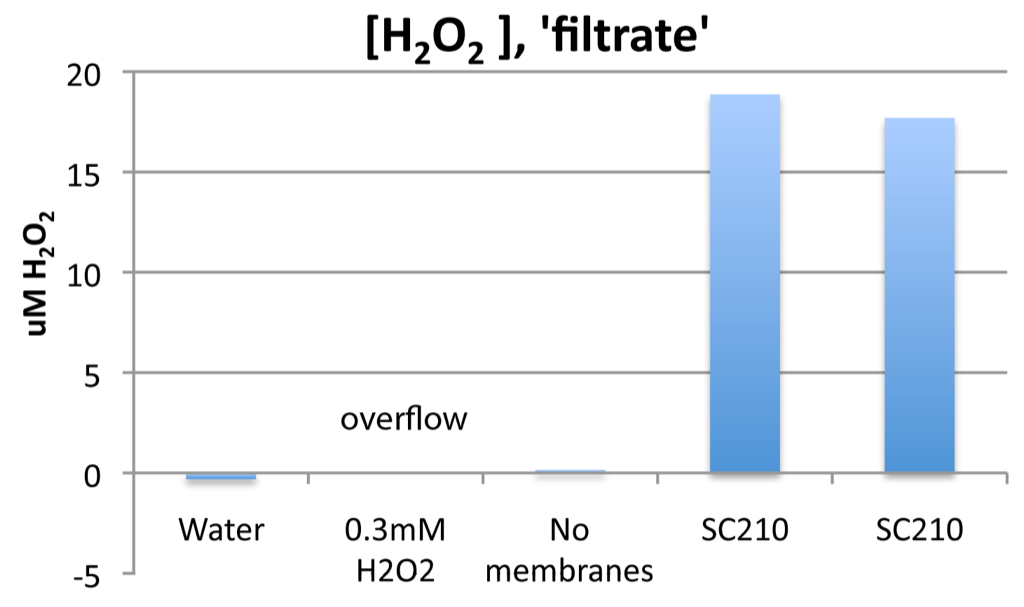
The water sample is the blank. The 300μM H2O2 is the stock solution that sit in 1 well of a 24-well plate for 24 hours (to control for possible H2O2 degradation). ‘No membranes’ is a chip with no membrane windows. There were 2 SC210 samples (both without pinholes). The H2O2 stock overflowed because it was more concentrated than the highest standard concentration, off of which I had set the gain. With no membrane, there was no diffusion (and no leaks). The SC210 samples were about the same – we got strong signal from both of the wells. This wasn’t too surprising – H2O2 should have no trouble passing the pores of an intact membrane. This might be interesting for Jess to analyze (or for her to give us samples to test) since this is the smallest molecule we’ve tested for diffusion through pnc-Si (except salts with the conductivity probe).
What are the components of the amplex red kit?
The buffer is just PBS. The amplex red reagent is 10-acetyl-3,7-dihydroxyphenoxazine, which is dissolved in DMSO just prior to use. This reagent reacts with H2O2 in the presence of peroxidase to form the red fluorescent resorufin. The source of peroxidase for this kit is HRP.
HRP is a 44kD protein, and so its diffusion should be much, much slower than H2O2. Thus if the bottom well had all the color generating reagents beforehand (including HRP) and we added H2O2 to the top well, could we monitor the diffusion of H2O2 across the transwell in real time? Confounding signal from the top well should not be a problem because the backwards transport of HRP should be minimal. Does this sound plausible? I would like a quick quantitative assay of small molecule diffusion that could be used to characterize membranes.
Jim – in theory, that should work. The volume of the color-generating reagents is large enough to fill 1 well of a 24-well plate (~750uL). I worry about the stability of those reagents, however. Several of them are air-sensitive and are stable for <1 day. Hours-long assays should be fine but longer than that would have to be tested. Also, this assay seems expensive. With 1 vial of Amplex Red, we could do 5-6 real-time tests of pnc-Si transwells in 24-well plates with ~750uL reagent per well. That’s about $8/well based on what we paid for the kit. I assume that if we buy the components separately, the per test cost would be lower.