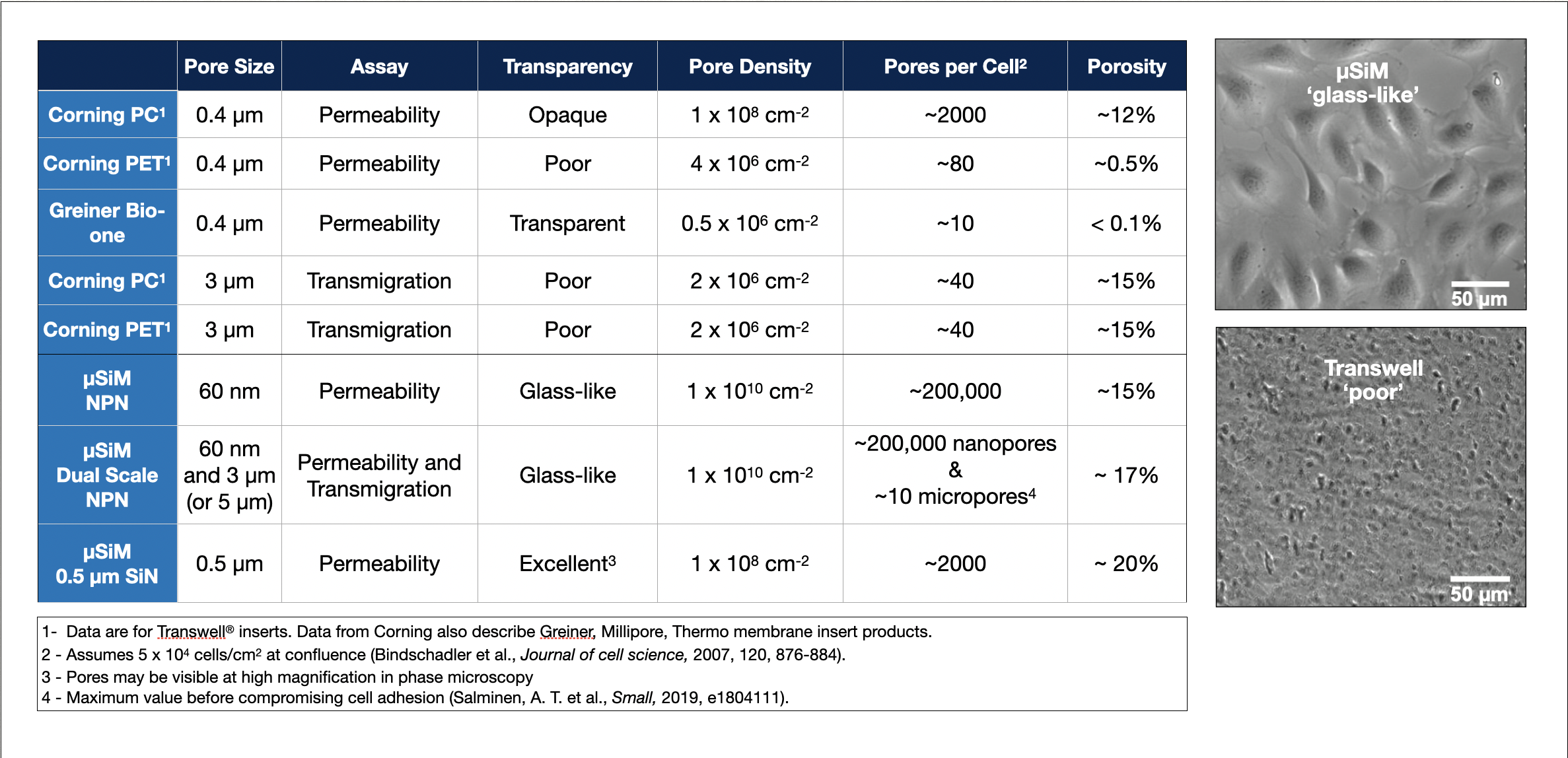
The modular architecture of the µSiM serves as a flexible development platform enabling the creation of a limitless number of tissue models that match the needs of particular projects. The common design principles are the use of ultrathin, silicon-based, porous “nanomembrane” chips as a tool for separating apical and basal compartments of the device, a multiwell-standard 9 mm × 18 mm footprint, and the use of strong but reversible pressure-sensitive adhesives that enable the rapid (minutes) assembly of devices without the need for microfabrication resources orexperience. The unique ultrathin membranes enable seamless imaging, molecular and cellular exchange, and even direct cell–cell contact between tissue compartments. The common footprint enables access to scaled manufacturing and multiplexing strategies that work with industry standards. It is the PSA-based assembly that enables a mix-and-match architecture where each component can be exchanged for another design. This makes each component an optional module that can be swapped to create a chip variant, a control, or an entirely new tissue model.
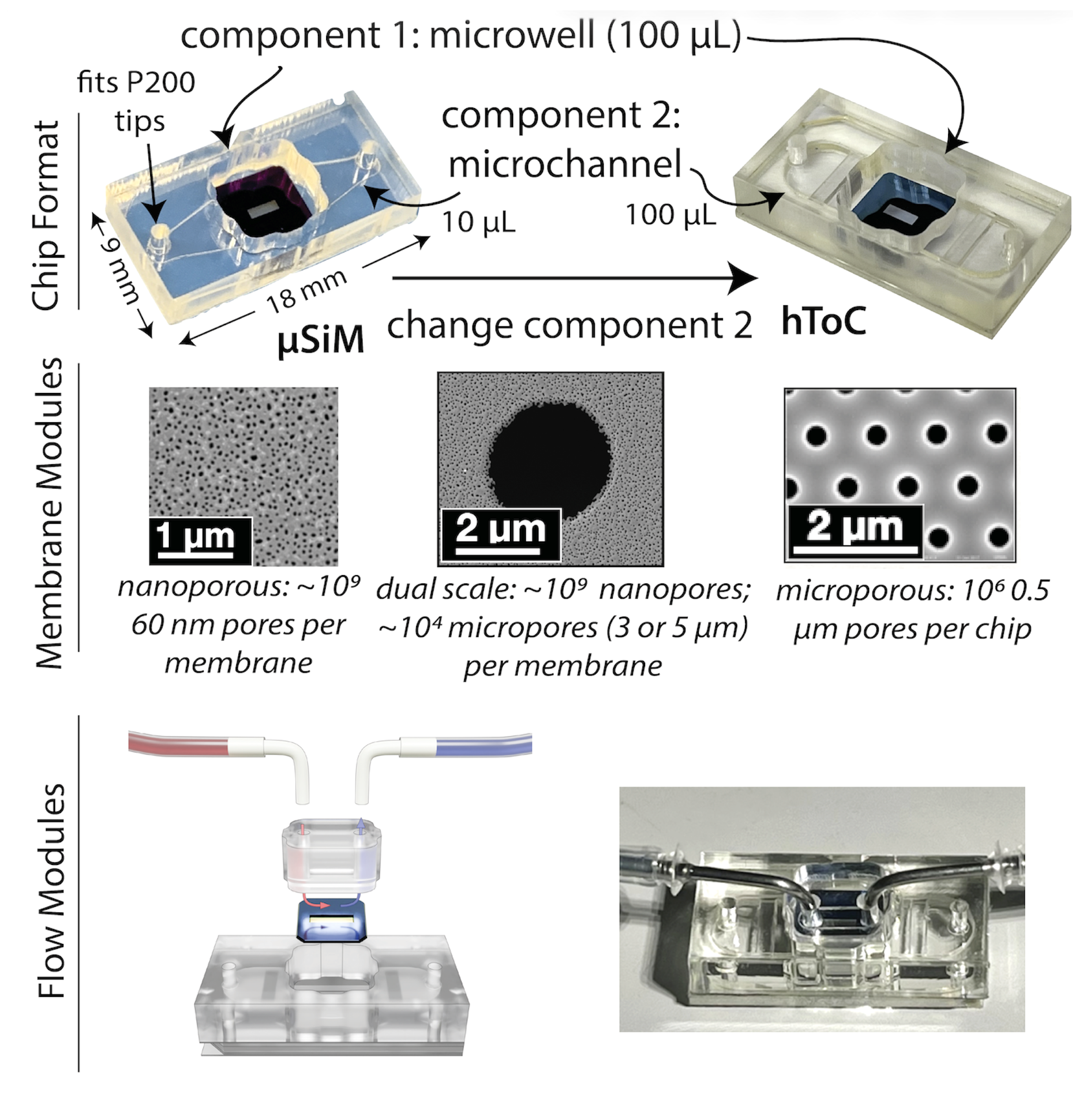
The membranes, for example, can be treated as fully independent modules—nanoporous membranes for unrestricted diffusive signaling, dual-scale membranes for transmigration and contact assays, or microporous membranes when mechanical coupling or structural interaction is required. Likewise, the top and bottom components can be exchanged to introduce microchannels, deep chambers, hydrogel anchors, or specialized access ports, all without significantly altering methods for device handling, cell seeding, imaging, or compatibility with accessories and expansion options. Expansion to flow can be achieved for any µSiM-based chip via the PSA-based addition of a flow-insert module. In this way, a growing library of interchangeable elements creates a development toolbox built on a common and well-understood underlying architecture, yet offering boundless options for redesign and reconfiguration tailored to the needs of novel tissue-on-a-chip applications.