
Using osmotic pressure to suppress back pressure
The basic principle of inducing the osmotic pressure to suppress back pressure is based on the counterbalance of the opposing flows of solvent. Consider an electrolytic cell composed of a pair of Ag/AgCl electrodes and a Nafion-coated pnc-Si membrane separating NaCl solution into two halves.
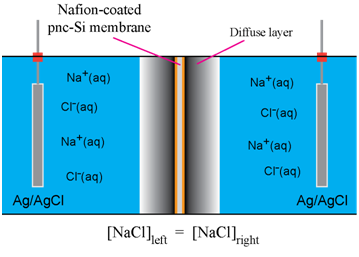
Initially, the electrolyte in either half has the same concentration so that the electric double layer (EDL) formed over the negatively charged surface of Nafion is identical on both sides of the membrane.

When the potential is applied across the cell, the electrochemical reaction starts at both electrodes; AgCl is formed on the surface of anode, while consumed at the surface of cathode. Sodium ions transport in the same direction as the applied field across the membrane. The chloride ions travel in the opposite direction; however, unable to across the membrane.

The cation-exchange capability, bestowed by the strong negative fixed charge of sulfonic group, of Nafion prohibits the diffusion, electromigration, and convection of chloride ions.

As a result, the chloride ions accumulate on the cathode side of membrane, while depleting on the anode side. According to the electroneutrality principle, sodium ions as the supporting electrolyte behave in the same fashion; the concentration of NaCl on the cathode side of membrane is then higher than that on the anode side, unbalancing the thickness of EDL on either side.

Lower concentration produces thicker EDL on the anode side of membrane. These unbalanced diffuse layers of sodium and chloride ions lead to the concentration difference across the membrane. Since chloride ions cannot diffuse across the membrane and sodium ions must stay with chloride to maintain charge neutrality, the osmosis of water is the only possible transport to occur. Note that the osmosis of water is in the same direction as the applied field as described by the conventional transport theory, for a single pore:

where Q is the solvent flow rate, P is hydrostatic pressure, πos is osmotic pressure, φ is potential across the membrane, lp is pore length, cb is bulk concentration, and F is Faraday constant. The coefficients K1 and K2 are defined as


where μ, rp, and c+ represent the viscosity, pore radius, and concentration profile of sodium ions, respectively. Notice that the solvent transport equation indicates that the flow of solvent is contributed by the pressure driven flow, osmosis of water due to concentration difference, and electroosmotic flow. Rearranging the terms and rewriting the osmotic pressure as πos = RTc gives the transport equation as

where R, T, and c are the universal gas constant, absolute temperature, and concentration of solution, respectively. The first term indicates the opposing flows driven by hydrostatic pressure and the osmosis of water – originating from the induced concentration difference as illustrated in the figures above. This transport equation suggests the feasibility of using the osmotic pressure to suppress back pressure.