
Pressure Cell Update
This past week I ran multiple experiments using the pressure cell and sep-cons. I used membranes from W684 for the sep-cons since the burst pressure of these memebranes is high (around 3.65-10Psi). I added 100uL BSA to the Sep-Con and put 20uL 1xPBS on the backside. Before adding the NC to the sep-con, I assembled the sep-con into the submarine, and to the pressure system. This way, if the membrane burst, I would know right away, without the NC getting in the way.
Once assembled I added a pre-wet square of NC to the end of the sep-con, as shown in the picture below. At first I put vacuum grease on the NC so it would stick to the sep-con, but I realized that is will stay put on the sep-con without the vacuum grease. Another problem witht the vacuum grease is that any BSA that goes through the membrane sticks to the vacuum grease in clumps, instead of on the NC.
I let the system run for 35-50 minutes, checking the pressure every 10-15minutes to ensure that it is steady around 2Psi. I noticed a puddle of liquid forming under the sep-con. This is most likely due to the fact that W684 has pinholes, which increase the flux rate through the membrane.
This set-up seems to work consistently for 1mg/mL BSA, however, just because we can detect BSA through a sep-con, onto NC after 40 minutes, doesn’t mean we’ll be able to detect the proteins that Harold Smith needs tested. If the protein concentration is too low, this set-up may not work.
Moving forward… Since this set-up works with one sep-con in the submarine, I’m going to try to build a submarine that holds 10 sep-cons. That way I can run 10 experiments simulatneously. This will come in handy with Harold’s solutions, since he has 20,000 solutions at one concentration that he wants tested.
 table of detected protein through W684
 no protein detection
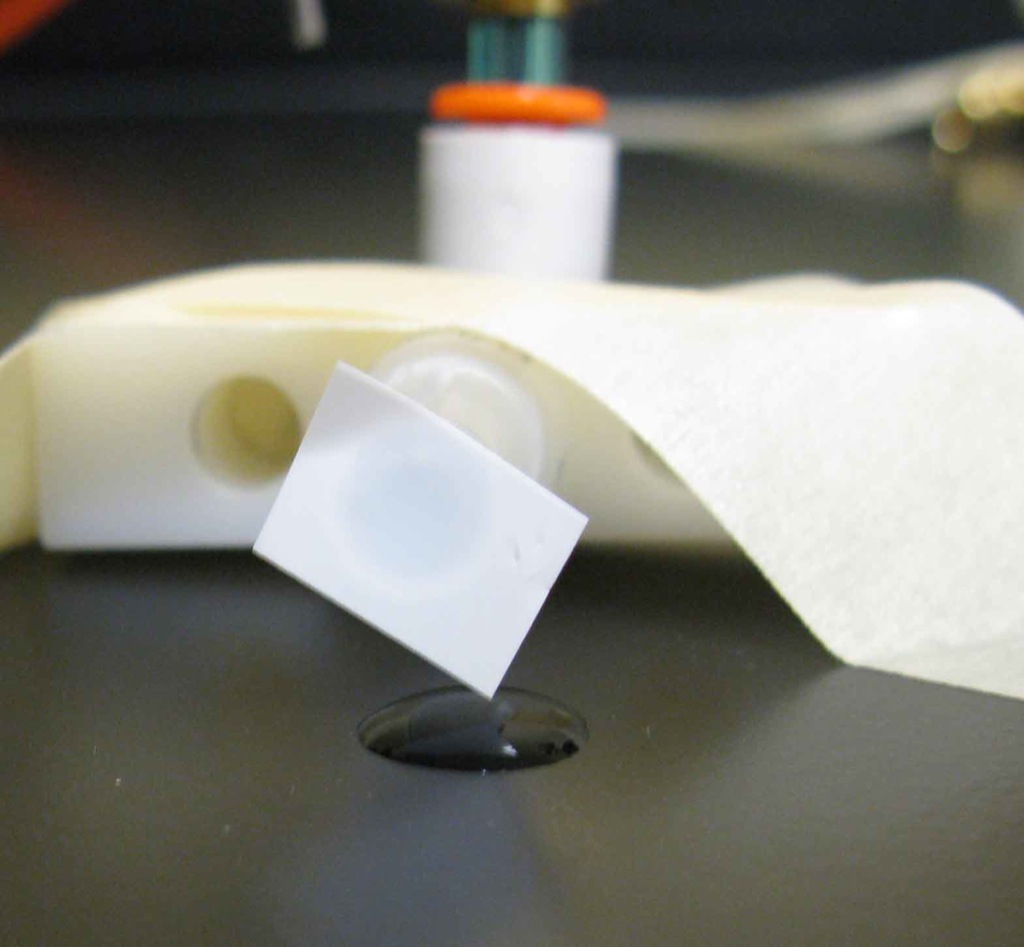
puddle forming under the Sep-con due to high flow rates through the pinholes.