peg X-linking
Purpose: The purpose of this investigation was to study the diffusion of Rhodamine, a florescent dye, in crosslinked Poly ethylene glycol (peg) using a Leica DMI 6000. Knowing the permeability of crosslinked peg is valuable as peg is a potential material for the hemodialysis project particularly the lift off component, and knowing about Rhodamine’s (MW = 400g/mol) ability to permeate PEG could help model a molecule of interest such as HF in the future.
The experimental setup: a microfluidic channel was created using a gasket cut from pdms (100um) and sandwiched between a slide and a coverslip. Space was left at either end to load peg and then wick it off with a Kim wipe to pull in the Rhodamine with capillary action. (figure 1)

Figure 1: Microfluidic channel version 3, it capable of having 3 trials run in series on the same slide, it is optimized for ease of assembly and number of trials per slide.
The procedure is as follows: (high level overview)
1) Load peg solution ( either 1:1 or 2:1 with 3%photo initiator)
2) Crosslink using Dapi (360nm) (figure 2)
3) Observe and capture under TR
4) Flow in Rhodamine dye using capillary action
5) Wait and analyze video, (sampled 1 frame / 5 sec, 15min runtime)

Figure 2: an Image of the Peg feature in phase, it is a solid cross linked column with potentially curved walls.
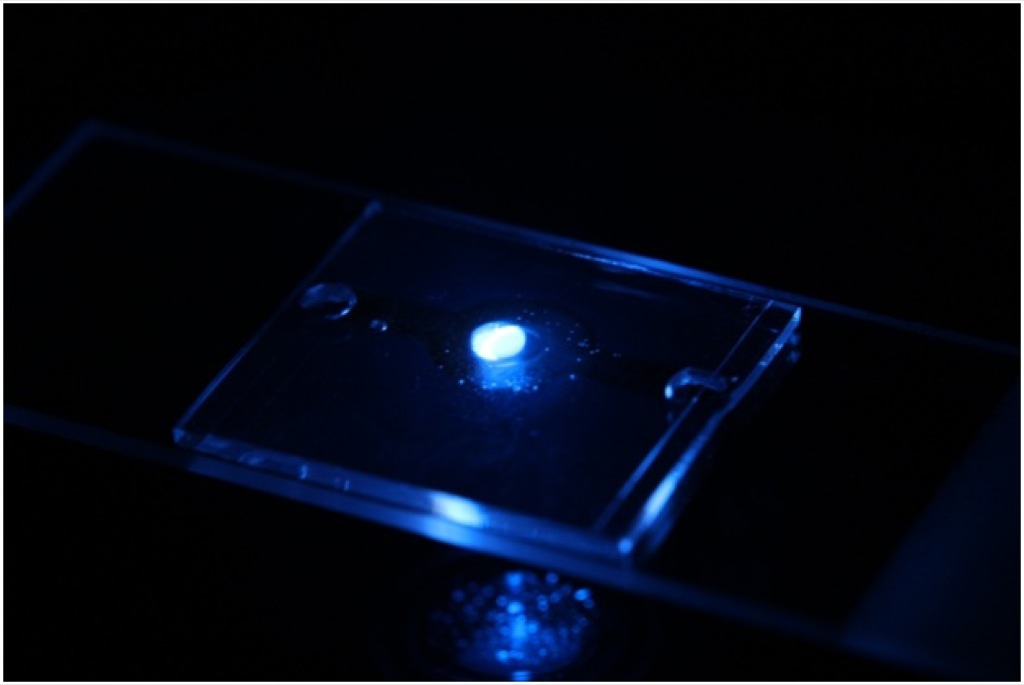
Figure 3: a generation 1 microfluidic channel under the microscope the feature can be seen in the center slightly to the right of the beam.
Obstacles and findings : first obstacle encountered was that the peg feature appeared too bright, which superficially would indicate moving up a concentration gradient (pic), which we know is not possible with passive transport. (figure 4, movie)
http://www.youtube.com/watch?v=7UVPODKbBOQ
Autoflorescence would have been present in the center of the object so it was rule out as the cause after experimental verification. Florescence is of course based on the assumption that the reading on the ccd camera can give a linear approximation of the amount of Fluorophore in the surrounding area, so I tested the same concentration of Rhodamine in DIH20 and Peg and found that for a given concentration, peg( uncrosslinked at this point ) gave a roughly ten times greater signal than DIH20, despite the fact that their controls ( without dye) had around the same level of florescence. And additional note is that no matter what the level of crosslinking, the peg will amplify (multiply) in the same manner. (figure 5).
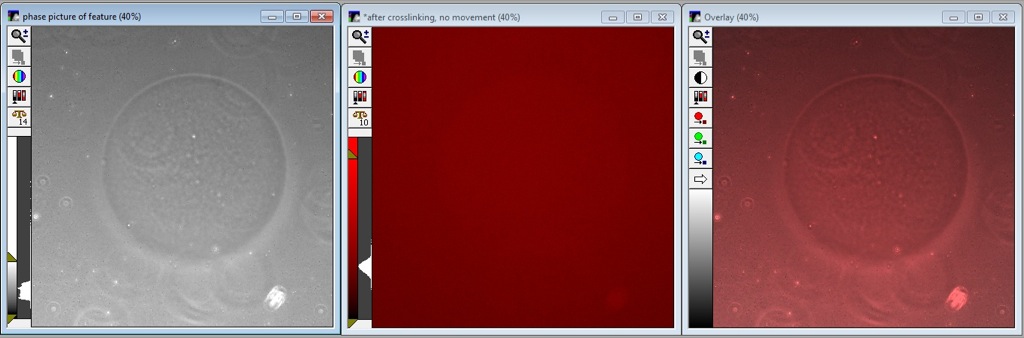
Figure 5: from left to right shows phase of the peg feature, peg and Rhodamine (x-linked), and an overly of the two, there is no way to tell that the peg feature I there using only the florescence image.
In theory at time infinity (equilibrium) this amplification would produce a split function, but instead what is observed is a profile that looks like it is subject to some optical effects (figure 5). ( this is speculatory)

Figure 6: peg feature surrounded in Rhodamine+ DIH20, supposedly at equilibrium (2+hrs from time of rhodamine introduction) observe the line profile.
Future plans for analysis: The optimal situation would be the ability to apply a compensatory transform to the data to relate brightness ( gray levels) to concentration, and to generate a diffusion model with and from there a diffusion co-efficient. (figure 6)

Figure 6: shows graphs of intensity readings vs. position, graphs one and three are speculatory, graph 2 has been experimentally observed.
When I ran the experiment in reverse by putting Rhodamine in the peg, flowing it in, crosslinking it, then flowing in DIH20 and watching the dye run out, the edge effects seen in fig 6 were not seen in. (figure 7)
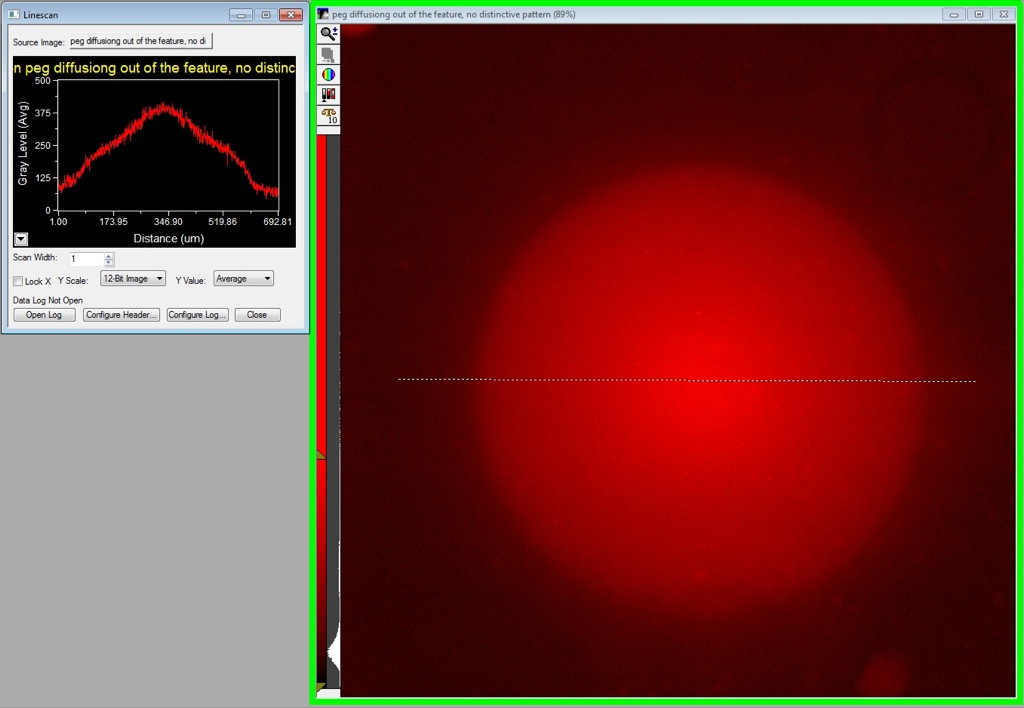
Figure 7: crosslinked a homogeneous solution of peg and Rhodamine and then flowed in DIH20 and watched dye flow out, observed a drop in the center over time which implies diffusion.
Discussion: Input on what could be causing the profile observed in figure 6 (coupling ect.) Ideas for further experimentation, general comments.