
Protein Separations with w612
After doing all the water permeability with this wafer, I saved the samples to do some protein studies. When I write my own paper I will need two wafers to separate protein standards by diffusion and flow to show movable cutoffs. I will also include a brain extract separation to make the point that you can use really messy protein samples. Since protein standards are way more expensive and I wasn’t sure if the separation would work this time around, I jumped on the brain extract first.
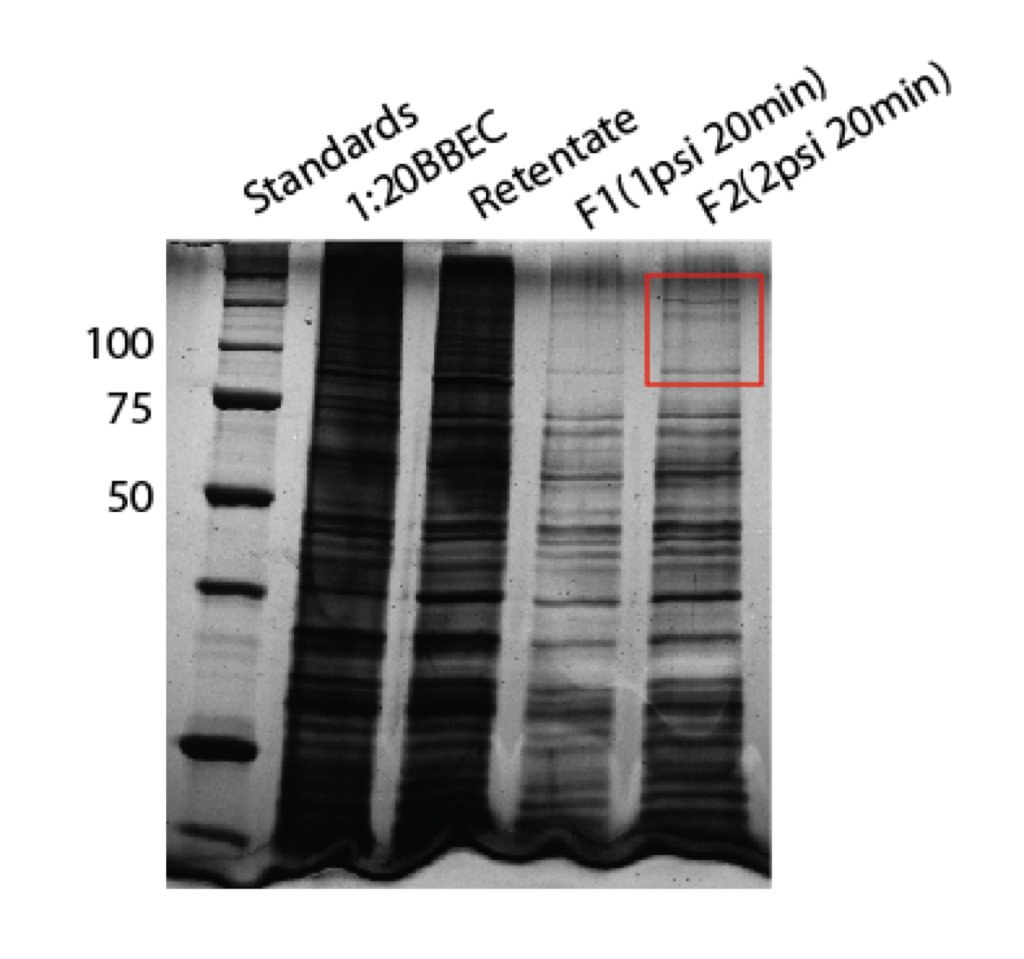
I first performed a separation with the pressure cell. This apparatus takes a SepCon and pressurizes it with nitrogen. You need to put a small drop of buffer on the back side though, since these won’t work wet/dry. I pressurized at 1psi for 20min with 20ul on the backside for F1. I then upped the pressure to 2psi for 20min with only 10ul on the backside (I’m trying to limit filtrate dilution) for F2. The R is the same just because I barely passed anything at all through the membrane. I didn’t expect this system to work since it didn’t seem like anything at all was going through. Here are the results of this separation:
The second method I tried was a slightly modified EQ format. I reduced the outside reservoir volume as much as I could to limit the amount of filtrate dilution. I then spun these at 1000rpm for 4 hours. There are two different samples recorded here:
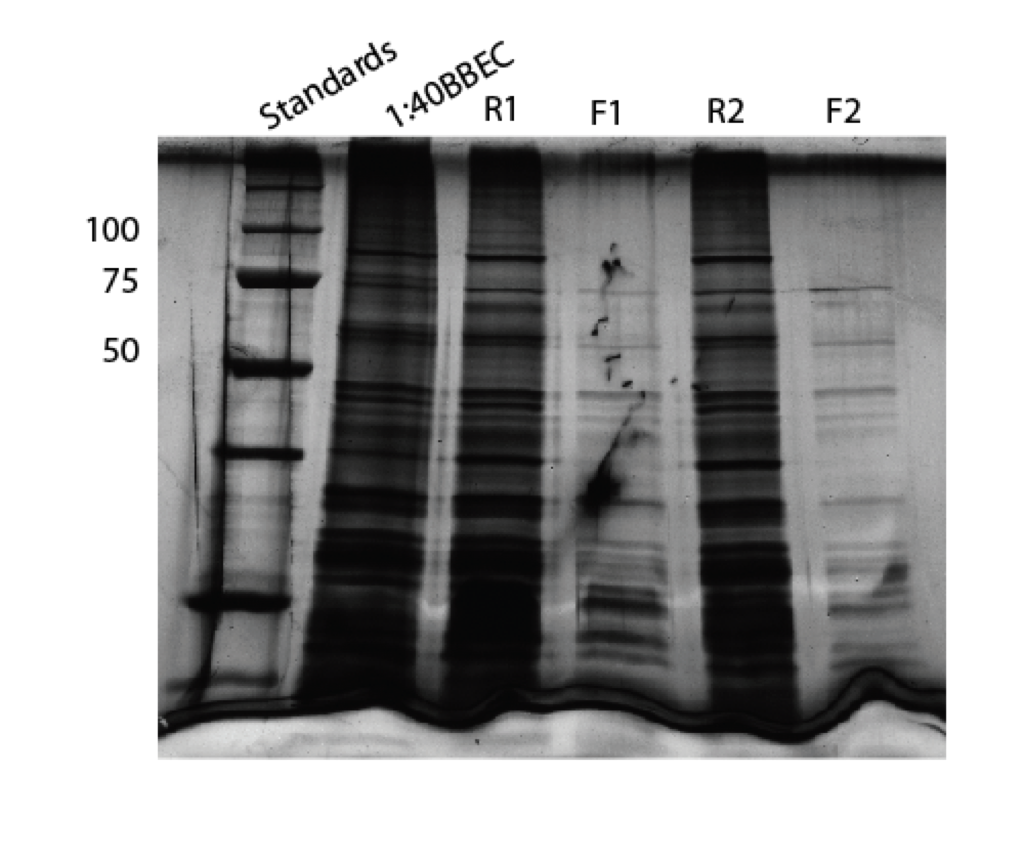
Pressure cell seems more sensitive, and even shows us some higher sized proteins that seem to start getting through this membrane. It’s hard to designate a cutoff seeing this. These gels are a bit overstained, and the amount of protein we’re seeing in that red box is only a tiny part of the total. The EQ gel on the other hand looks like we’ve got a cutoff around 75kD. One thing to keep in mind though is that the pressure cell started off with more concentrated BBEC (1:20 rather than 1:40) and had less dilution on the backside. It did however run at a lower pressure and a much quicker time. I worry about long EQ runs because we’re starting to get into diffusion territory.
I think we need to try a good standard diffusion separation with this (Rachel tried but the gel didn’t turn out great) and if that has a good cutoff move on to a stardards pressure cell separation.
How much does the flow decrease with this solution, relative to the water flow rates? Since we pass so little fluid, I doubt we are forming a cake layer or any type of polarization layer. It’s either a viscosity issue or we are adsorbing a layer of protein to the membrane immediately that’s changing it’s properties. Any thoughts?
Roughly I’m getting a permeability of 70 ul/(min*psi*cm2) as compared to the water flow rate of 700.
Adsorbing is going to occur, but it’s interesting to add that we know just PBS alone will reduce flow rates. We’ve never discussed why PBS may have an effect. The viscosity of PBS should be similar to water I think.
Wow – a 10X drop in flow is huge. How much will PBS alone drop the flow rate? Have we absolutely confirmed this effect, as it would be difficult to explain a large difference due to PBS alone? Do the nanoseps and microcons show these same dynamics? If they do not, we may need to start functionalizing the membranes to reduce binding and neutralize charge.
So Tom did a test a while ago where he tested a membrane with water, then went back and tested that same membrane with PBS and saw a 2x flow decrease (655 -> 330). We haven’t done any other tests like that since.
I’m not sure if we ever tested PBS in microcons or nanoseps… Mike do you recall?
I checked, and we never tested PBS in either the microcons or the nanoseps.
I think running tests like this in the microcons and/or nanoseps would be a good idea because we need to identify what observations are specific to our material and what is general to all nano-filtration. We can learn a lot from similarities and differences to existing materials.
Can we do this quickly – seems easy enough. How should it be done? Run water, then buffer, then water again through the same unit? No sense burning too many. I’ll let the experts design the experiment…
We should also add aminosilane to a few of the the sepcon membranes to see if there is an obvious difference in flow rate, as I suspect this is mostly electrostatics…